


- According to KPMG, 93% of US companies plan to deploy or scale AI in finance within 18 months, while Gartner predicts agents will handle 15% of daily work decisions by 2028.
- Finance AI agents can handle portfolio management, insurance, customer communication, credit underwriting, financial planning and forecasting, regulatory change monitoring, reporting and analytics.
- Real-world use cases of AI agents include month-end close automation, investment portfolio rebalancing, insurance proposal generation, borrower risk scoring, and real-time executive dashboards.
- Based on our project experience, finance teams using AI agents can cut data retrieval time by 50%, eliminate hundreds of broker hours annually, and achieve 100% accuracy on repetitive portfolio tasks.
- Best candidates for AI agent automation include reconciliation, reporting, forecasting, invoice processing, compliance checks, and credit underwriting.
Unlike chatbots, AI agents can analyze data, make decisions, and take actions on their own, making them a great fit for finance teams handling large amounts of data. Explore the top AI agents for finance based on real-life examples.
According to Gartner, by 2028, one-third of enterprise software applications will include agentic AI capabilities, and AI agents will autonomously handle at least 15% of everyday work decisions.
Finance teams constantly deal with repetitive workflows, strict compliance requirements, and pressure to move faster. Unlike basic automation tools, AI agents can understand context and help manage complex, multi-step tasks across different systems.
Below, we’ll share real-world AI agents for finance use cases, including examples based on our AI agent development experience.
What Are Enterprise AI Agents for Finance Teams?
AI agents for finance teams are intelligent software systems that analyze data, make decisions, and complete financial tasks with minimal human input.
Finance agents can understand business context and handle complex financial workflows, reconciliation, reporting, portfolio management, and forecasting.
Let’s see how this works in practice. Imagine a finance team during the month-end close. One AI agent matches invoices with purchase orders, another flags discrepancies, and a third prepares reports for the team. These agents seamlessly work together behind the scenes and learn from past actions and exceptions, helping teams complete processes faster and with less manual work.
How AI Agents Are Used in Finance?
AI agents help finance teams work faster by analyzing financial data, generating insights, and automating repetitive workflows.
According to the 2026 report by KPMG LLP, the US audit, tax, and advisory firm, 93% of US companies plan to deploy or scale AI within their finance functions over the next 18 months. Here are some common ways AI in finance departments is used today:
- Answering finance questions. Ask something like “Why were our operating costs higher than expected this quarter?” and the AI agent can review transactions, invoices, and reports to explain the main drivers behind the change.
- Analyzing financial changes. AI agents can review invoices, contracts, and reports to explain budget vs. actual differences.
- Automating reconciliation and reporting. Finance agents can match transactions, flag discrepancies, and automatically generate reports.
- Preparing documents for audits. AI solutions for finance can collect supporting documents and summarize required information to speed up audit responses.
- Researching investments and market trends. Portfolio and investment agents can analyze market data, compare benchmarks, and summarize insights for faster decision-making
Top 7 AI Agents in Finance
Different AI agents are designed to help with different financial workflows, whether it’s reconciliation and reporting or investment analysis. Below are some of the most common examples of how finance teams use AI agents to automate their financial operations and make informed decisions.
1. Portfolio Management AI Agent
Portfolio management AI agents help financial teams monitor investments, assess risks, and optimize portfolio performance in real time. They analyze market trends, client goals, historical performance, and live financial data to support faster and more informed investment decisions.
Instead of manually reviewing reports and market movements, finance teams can use AI agents to automate portfolio analysis, rebalancing, and performance tracking. Based on Akveo’s project-based experience, AI agents can handle up to 100% of repetitive manual tasks while achieving 100% accuracy.
Key functions of portfolio management AI agents:
- Portfolio monitoring. Finance agents track portfolio performance, market changes, and asset allocation in real time.
- Portfolio rebalancing and wealth management. AI agents recommend or automate adjustments to keep portfolios aligned with investment goals.
- Performance reposting. Automatically generate portfolio summaries, investment reports, and performance insights.
- Market research and trend analysis. Analyze market data and historical trends to support investment decisions.
Akveo’s real-life example:
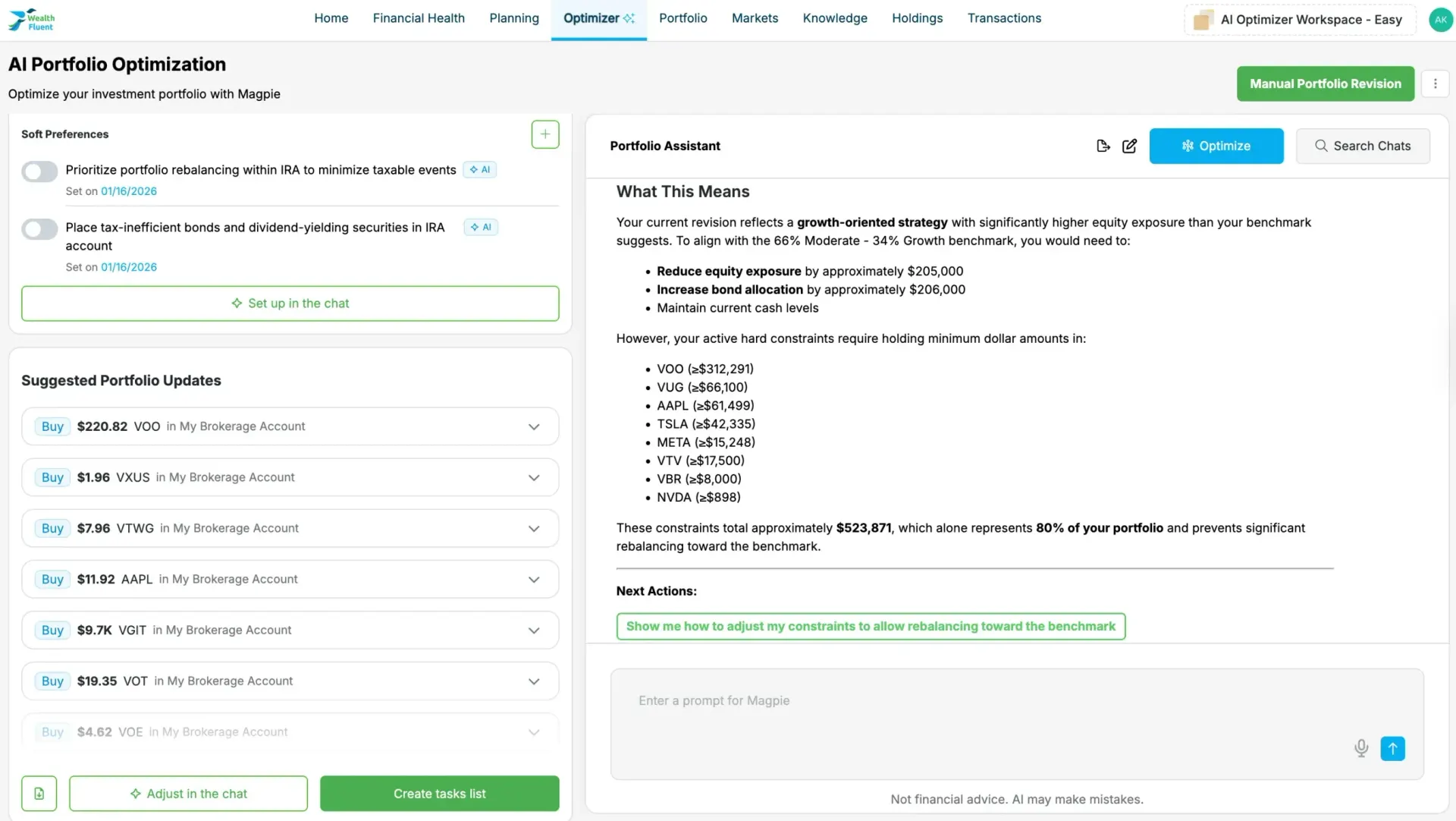
Our client, a U.S.-based fintech company democratizing financial planning, had a powerful investment platform, but many users felt overwhelmed by complex charts and financial data. The goal was to create an AI companion that could explain investment insights in plain English and make wealth management more accessible.
The main challenge was handling large volumes of data in real time without sacrificing speed or accuracy. Akveo engineers built an wealth management AI agent that acts like a financial educator. It analyzes data and explains trends, helping users make informed decisions while staying compliant.
The AI agent continuously optimizes portfolio recommendations and routes tasks between different AI models to balance advanced reasoning with fast responses. As a result, users now receive data-driven investment insights. Plus, AI handles 100% of the onboarding process that previously required human support.
2. Insurance AI Agent
Insurance AI agents help brokers and agencies automate document handling, proposal generation, and customer workflows. Instead of manually reviewing insurance files, searching through documents, or managing repetitive onboarding tasks, these agents organize information and generate insights, streamlining broker operations in real time.
Based on our project experience, insurance AI agents can save thousands of broker hours annually.
Key functions of insurance AI agents:
- Proposal and quote generation. AI agents help brokers generate insurance proposals and compare policies faster.
- Document management. Insurance AI agents can organize, review, and retrieve insurance documents and uploaded files.
- Policy comparison. Analyze coverage details, pricing, and policy differences across multiple providers.
Akveo’s real-life example:
Akveo worked with an AI-powered insurance platform designed for brokers and agencies. While the client already had a strong AI engine, the platform’s user experience made complex workflows difficult to manage. The goal was to simplify how brokers upload documents, generate proposals, compare insurance options, and manage subscriptions.
Our team redesigned the platform for a better user experience and introduced conversational AI flows, intelligent document handling, live progress updates during AI processing, and automated email flows.
As a result, the AI-powered platform saved more than 1,500 hours of broker time annually while reducing friction across onboarding and proposal generation.
3. Customer Communication AI Agents
Google Cloud Study reveals that 49% of cross-industry applications for AI agents were customer service and experience.
Customer communication AI agents help financial companies automate client interactions across email, chat, voice, and customer portals. These finance agents can answer account questions, schedule meetings, and send personalized follow-ups, guiding customers through financial processes without constant human involvement.
Key functions of customer communication AI agents:
- 24/7 customer support. Answering account questions, guiding customers through common requests anytime, 24/4 access to mobile banking services.
- Personalized financial recommendations. Finance agents can suggest savings plans, account options, and financial tips based on customer behavior and goals.
- Meeting scheduling and follow ups. AI agents automatically book appointments, send reminders, and follow up after client interactions.
- Customer onboarding. Guide users through document collection and account setup processes.
4. Reporting and Analytics AI Agents
Reporting and analytics AI agents help finance teams automate financial reporting, variance analysis, and executive dashboards. They pull data from multiple systems, analyze financial changes, and generate reports. This saves finance teams many hours manually updating spreadsheets and preparing reports.
Advanced AI agents use generative AI models to perform complex financial calculations, analyze large datasets, and generate real-time dashboards and insights.
Key functions of reporting and analytics AI agents:
- Automated financial reporting. AI agents generate financial statements, dashboards, and reports automatically.
- Performance analysis. Finance agents can compare actual performance against budgets and forecasts to identify important changes and trends.
- Data reconciliation. Pull and validate financial data across ERP, accounting, and reporting systems.
- Executive dashboards. AI agents can create real-time dashboards with KPIs, trends, and performance summaries for leadership teams.
Akveo’s real-life example:
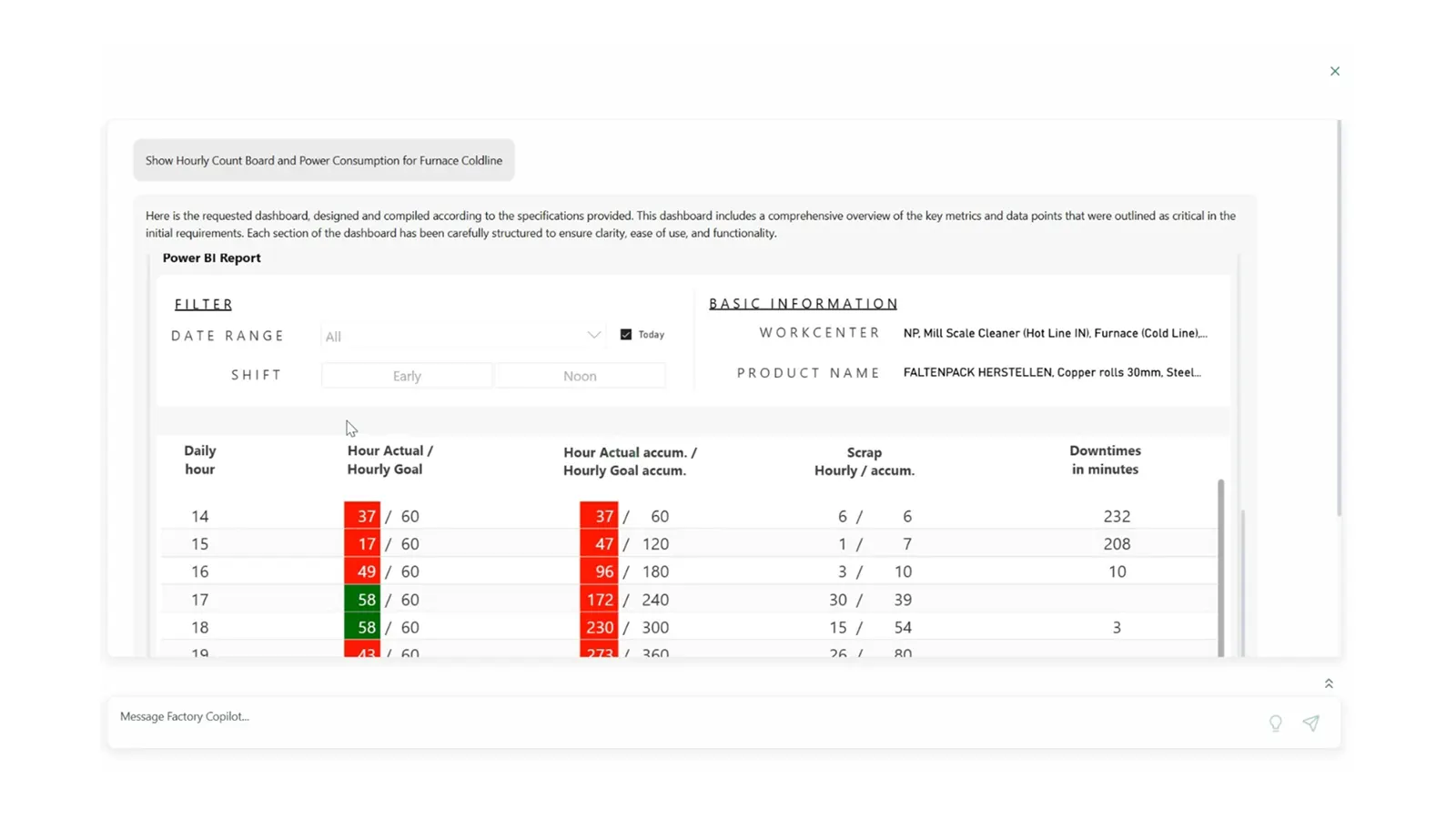
At Akveo, we regularly receive requests for AI agents focused on data analysis and reporting. This includes finance, insurance, and many other industries. For example, recently we developed an AI reporting chatbot for a manufacturing company. It gave operators and managers instant access to production insights and operational data.
The AI reduced data retrieval time by 50%, allowing teams to access real-time reporting insights in seconds instead of minutes.
5. Credit Underwriting AI agents
Credit underwriting AI agents assess loan and credit applications, enabling faster and more accurate lending decisions. They evaluate both traditional and alternative data sources, including utility payment history, transaction records, and behavioral signals, to improve risk assessment.
While manual underwriting can take days, AI-powered underwriting agents can deliver decisions within minutes.
Key functions of credit underwriting AI agents:
- Credit application assessment. AI agents review borrower applications, financial profiles, and credit histories to evaluate eligibility and risk.
- Alternative data analysis. Analyzing non-traditional data sources, including utility payments and transaction behavior.
- Document validation. Verifying submitted documents, income statements, and supporting records for accuracy and completeness.
- Automated decision-making. Generating real-time credit approvals, rejections, and recommendations.
6. Financial Planning and Forecasting AI Agents
As finance teams face increasing pressure to deliver faster insights, AI-powered fintech solutions and forecasting tools are becoming a key part of modern finance operations. Based on the KPMG LLP 2026 report, the biggest opportunity for AI in finance is generating faster, predictive insights to support better decision-making, with 45% of companies highlighting this as a top benefit.
AI agents can help finance teams generate faster insights by analyzing historical performance, cash flow, operational data, and market trends. Instead of manually updating spreadsheets and building forecasts from scratch, finance teams can use AI agents to continuously monitor financial performance and adjust projections in real time.
Key functions of financial planning and forecasting AI agents:
- Budget forecasting. Generating financial forecasts based on historical data, trends, and business performance.
- Cash flow forecasting. AI agents can monitor inflows and outflows to help teams predict future cash positions.
- Scenario planning. Simulating different business scenarios and modeling potential financial outcomes.
- Revenue and expense tracking. Monitoring financial KPIs and identifying unusual spending or revenue trends.
7. Regulatory Change Monitoring AI Agents
Regulatory change monitoring AI agents track updates from regulatory bodies and industry standards, helping financial institutions stay compliant and reduce regulatory risks. These agents monitor regulatory publications, guidance updates, enforcement actions, and policy changes from organizations such as the SEC, FINRA, and Basel Committee.
Key functions of regulatory change monitoring AI agents:
- Regulatory update tracking. Monitoring regulatory announcements, rule changes, guidance documents, and enforcement actions across multiple jurisdictions.
- Policy gap analysis. Identifying areas where current procedures may not align with updated regulatory requirements.
- Policy and control recommendations. Finance AI agents can suggest updates to internal policies, controls, and governance frameworks to maintain compliance.
- Compliance reporting. Generating reports that document regulatory changes and remediation activities for audits and reviews.
How to automate finance workflows with AI agents
To seamlessly integrate AI agents into your finance workflows, start with processes that are repetitive, well-documented, and still handled manually. We recommend scoring each opportunity by impact, risk, and complexity, and focus first on high-impact, low risk, and low-complexity workflows.
Remember: the most successful implementations don’t try to transform everything at once. They start with a few specific bottlenecks and gradually expand as value becomes clear.
If you need help implementing AI agents or are not sure where to start with automation in your finance workflows, feel free to contact our AI development team. We’ve been building AI solutions for 10+ years and have already helped many finance companies integrate AI agents into their processes and achieve measurable results.
FAQs
What are AI agents?
AI agents are intelligent software systems that can understand context, make decisions, and take actions to complete tasks on their own. Unlike simple automation tools, AI agents can work across multiple systems, analyze data, and handle multi-step workflows with minimal human input.
What are the top AI agents for finance?
The top AI agents for finance include portfolio management agents, insurance agents, customer communication agents, credit underwriting AI agents, financial planning agents, regulatory change monitoring agents, and reporting agents.
What exactly do AI agents in finance do?
AI agents in finance help automate everyday financial tasks, including analyzing data, generating reports, processing transactions, and answering finance-related questions. They can also connect across systems and support faster decision-making with minimal human effort.
Which finance processes are best suited for AI agents?
AI agents work best in repetitive, data-heavy processes like reconciliation, reporting, forecasting, invoice processing, compliance checks, and financial analysis.
How long does it take to implement AI agents in a finance workflow?
It usually takes a few weeks to a few months, depending on complexity. Simple, well-defined workflows can be automated quickly, while more complex, multi-system processes take longer to design and integrate.
- KPMG LLP. AI in Finance 2026. KPMG US. Accessed May 21, 2026.
- Gartner. 3 Bold and Actionable Predictions for the Future of GenAI. Gartner. Accessed May 21, 2026.
- Google Cloud. Google Cloud Study Reveals 52% of Executives Say Their Organizations Have Deployed AI Agents. Google Cloud Press Corner. Accessed May 22, 2026.