







Access a full spectrum of EHR and EMR software development services — starting from scratch, integrating existing systems, or modernizing legacy platforms.
Make the right architectural and compliance decisions before writing a single line of code. Expert guidance helps define system scope, choose the right deployment model, and set a development roadmap aligned with budget and regulatory requirements.
What you get:
Build a custom EHR platform tailored to specialty workflows — not a generic solution stretched to fit. Full-cycle development covers clinical charting, patient management, billing integration, and role-based access for healthcare teams that need reliability at every touchpoint.
What you get:
Connect electronic health record systems with the broader clinical ecosystem. Seamless data exchange across imaging systems, labs, pharmacies, and third-party platforms eliminates manual entry and ensures unified patient data.
What you get:
Move patient records, clinical histories, and billing data to a new platform without disruption. Structured migration processes protect data integrity, maintain regulatory compliance, and ensure zero downtime for healthcare services.
What you get:
Extend the life of an existing EHR platform without a full rebuild. Legacy system assessment, performance optimization, and ongoing maintenance ensure the software keeps pace with evolving clinical workflows and compliance requirements.
What you get:
Discover how healthcare organizations replace fragmented records and reduce administrative workload with custom EHR and EMR platforms.
1,000+ patients served since launch
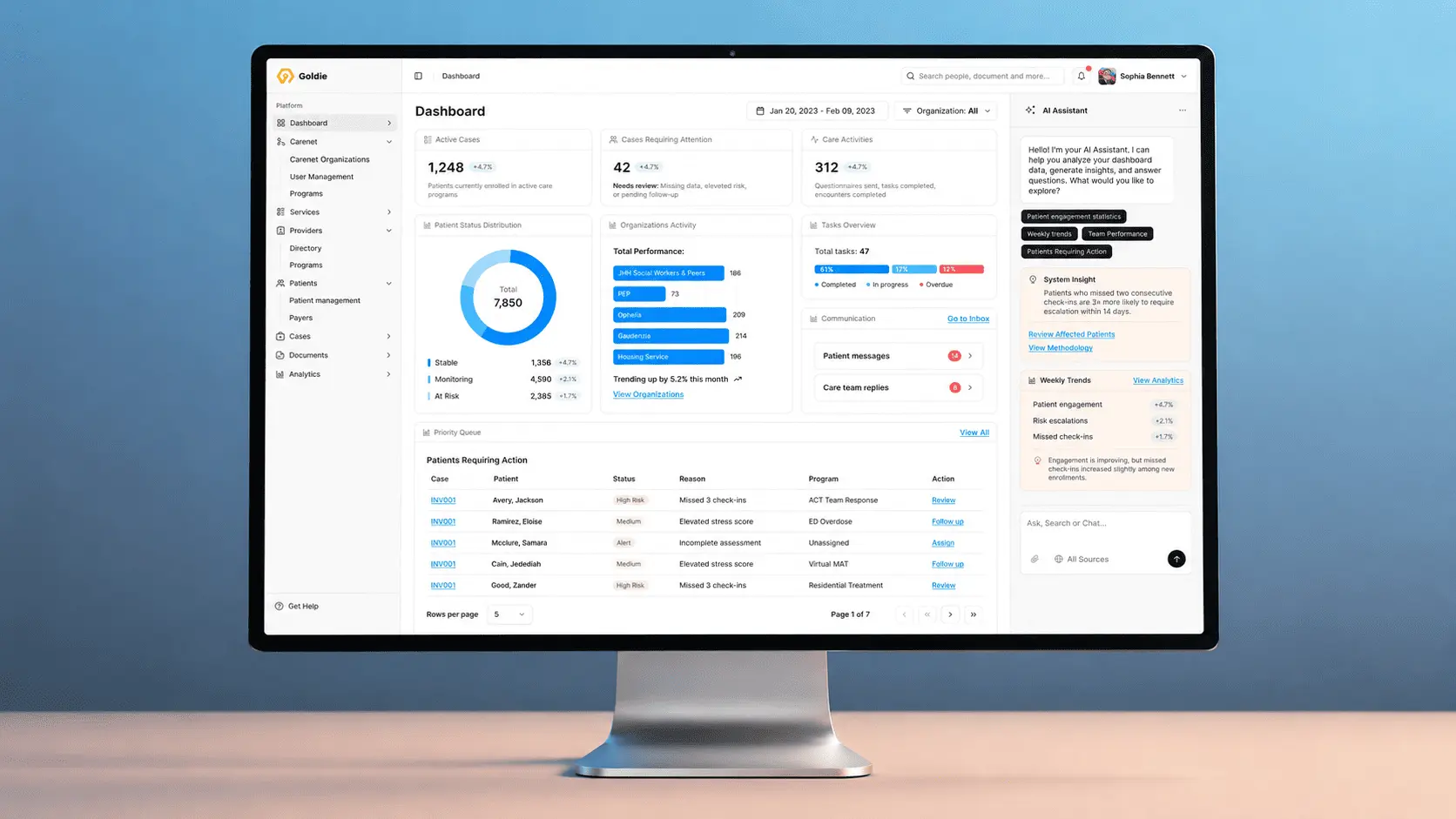
A secure, offline-first SaaS solution for opioid crisis response teams. This cloud-based platform uses a multi-tenant architecture to support multiple counties with strict data isolation, ensuring compliance with HIPAA and 42 CFR Part 2. Allows service providers to manage sensitive data and coordinate care in the field.

Partner with healthcare software specialists who understand both clinical workflows and regulatory requirements.

Every custom EHR development engagement starts with clinical workflow mapping. The interface is designed around how healthcare professionals actually document care — reducing clicks, surfacing relevant patient data contextually, and supporting automated documentation where possible.

We develop HIPAA Compliant software. It is embedded at the architecture level. This includes end-to-end PHI encryption, multi-factor authentication, role-based access control, audit logging, and secure data transmission across every layer of the stack.

Interoperability is built . Every integration with existing EHR platforms, third-party labs, or medical devices is designed for real-time, bidirectional data exchange with full audit traceability.

Custom EHR systems are architected around clinical workflows, documentation requirements, and patient engagement needs of each organization — whether serving mental health professionals, hospital networks, or healthcare startups.

Custom-built EHR solutions address this directly, with documentation flows designed to minimize repetitive data entry, surface smart defaults based on patient history. Clinicians spend more time with patients and less time with screens.

Our modular EHR architecture is built for change from day one, letting you add specialties, locations, roles, and workflows on demand, without downtime, costly migrations, or starting over from scratch.





Deep experience building compliant, workflow-specific systems across clinical settings.
Centralized patient history, clinical charting, e-prescribing, and appointment scheduling for high-volume practice environments.
Tailored EHR platforms for mental health professionals with therapy notes, treatment plan tracking, and patient communication tools.
Enterprise-grade systems handling complex multi-department workflows, clinical decision support, and cross-facility record access.
EHR platforms with integrated virtual consultations, remote patient monitoring, and asynchronous secure messaging.
Ophthalmology EHR systems and specialty documentation templates for unique diagnostic and procedural workflows.
Offline-first mobile EHR access ensuring care continuity for clinicians operating outside connected clinical environments.
Lean, scalable custom EHR solutions that give early-stage healthtech products a compliant foundation without enterprise overhead.
Progress tracking, care plan management, and outcome measurement tools built for extended patient journeys.
Technology selected for HIPAA-compliant, interoperable, and scalable clinical data systems.


Collaborate in a way that fits the healthcare organization's development goals and compliance timeline.
Get a full healthcare development team: solution architects, backend engineers, HIPAA compliance specialists, and QA. Ideal for enterprise EHR platforms and long-term product evolution.
Best for: Enterprise healthcare platforms, long-term EHR evolution.
Have a specific EHR build, integration, or migration scope delivered from start to finish. Full compliance and handoff included.
Best for: Custom EHR builds, system integrations, data migrations.
Need HIPAA or HL7/FHIR expertise? Add specialized healthcare software engineers to an existing team to accelerate delivery.
Best for: Teams needing HIPAA or HL7/FHIR expertise.
95% of our partners continue working with us beyond the initial scope and more than 70% stay with us for 2+ years.






An EHR software development company designs, builds, and implements electronic health record systems for healthcare organizations. This includes custom EHR development from scratch, integration with existing clinical systems, data migration from legacy platforms, and ongoing maintenance.
An electronic medical record (EMR) is a digital record of a patient's history within a single practice or department — used primarily by one provider. An electronic health record (EHR) is broader: it follows the patient across providers, facilities, and care episodes, designed for interoperability and multi-system data sharing.
An EHR developer is a software engineer with specialized experience building healthcare record systems. Beyond general development skills, EHR developers understand healthcare interoperability standards like HL7 and FHIR, compliance requirements like HIPAA and GDPR, clinical data models, and the unique UX constraints that come from building software for clinical environments.
No. A CRM manages relationships and communications with customers or leads. An EHR manages a patient's medical history — diagnoses, lab results, medications, treatment plans, clinical documentation, and billing codes. While both involve structured records and communication workflows, EHR systems operate under strict healthcare compliance regulations, require clinical interoperability standards, and are purpose-built for patient care delivery rather than sales or marketing operations.
EHR software centralizes patient data across every touchpoint of their care journey — from initial registration and clinical charting to lab results, imaging, prescriptions, and billing. Authorized healthcare professionals access the system via role-based permissions. Data flows between integrated systems, labs, pharmacies, imaging systems, insurance platforms, using interoperability standards like HL7 and FHIR.
Timeline depends on scope. A focused custom EHR for a single-specialty practice can be delivered in 3–6 months. Mid-complexity platforms with integrations, multi-tenancy, and patient portals typically require 6–12 months. Enterprise-grade EHR systems supporting multiple facilities and complex interoperability requirements run 12 months or longer.
In the US, EHR and EMR systems must comply with HIPAA — covering PHI protection, access controls, audit logging, and breach notification. Systems targeting interoperability certification follow ONC requirements. FHIR and HL7 govern data exchange standards.