







Access end-to-end energy software development services, from strategy through deployment and ongoing performance optimization.
Custom energy management systems are purpose-engineered to the specific asset types, data sources, and business rules of each organization — delivering smarter energy management that generic tools simply cannot.
What you get:
Renewable energy software is built to handle the complexity of intermittent sources, multi-site asset management, and grid interconnection — giving renewable energy operations the visibility and control needed to optimize resource utilization and maximize output.
What you get:
Unplanned downtime in the energy sector is costly — often exceeding $100,000 per incident for industrial assets. (ABB) Predictive maintenance platforms apply machine learning to real-time data streams, identifying failure signatures before they escalate. The outcome: higher asset uptime, lower operational costs, and longer equipment lifecycles.
What you get:
Aging legacy systems limit the speed, accuracy, and flexibility of modern energy management. Energy software integration services connect existing energy infrastructure with modern technologies — cloud platforms, IoT networks, and advanced data analytics tools — without a full replacement of operational systems.
What you get:
Increased total parking revenue and rental space occupancy
ParkIt needed EV charging infrastructure software integrated into its parking management platform: handling power balancing, permission controls, live energy usage statistics, and 24/7 monitoring. The charging module was built as part of a broader React, Java, and AWS platform developed over two-plus years, serving landowners, businesses, and residential properties across Sweden.


1st Place Innovation Award for automating complex vehicle energy systems
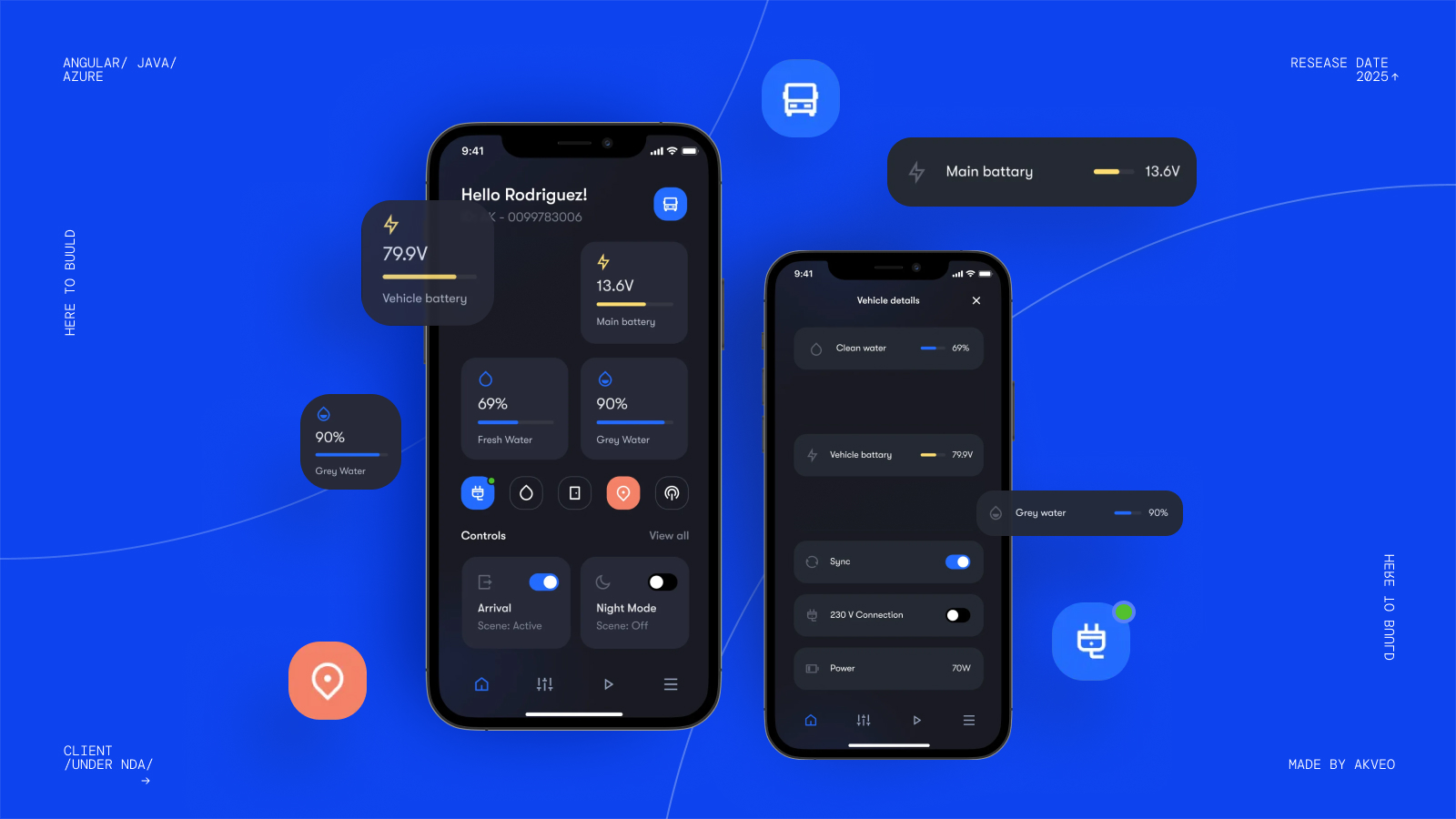
A leading European motorhome manufacturer wanted owners to control vehicle energy systems — lighting, heating, air conditioning, satellite, and battery management — from a mobile app. A React Native application was built for iOS and Android, connecting to the vehicle's onboard control unit via a secure Bluetooth Low Energy link and streaming real-time component status. Users can also manage vehicles remotely via cloud when out of Bluetooth range, and configure automated energy scenarios triggered by a single action.
Accelerated the annual rollout of 1,000+ ultra-fast EV charge points
E.ON Drive Infrastructure runs one of Europe's largest public EV charging networks, with a target of 1,000 new ultra-fast charge points per year. To keep pace without scaling internal engineering proportionally, an operational management platform was built on Retool — giving ops teams the real-time monitoring and site management tools needed to oversee a multi-country network from a single interface.

Maximized power plant profits and reduced CO2 emissions
Dispatchr is software for power plant operators that collects live equipment status and electricity market prices, then feeds that data into an ML model to generate the optimal plant configuration. The web application built with Angular gives operators a continuously updated recommendation engine, replacing manual market analysis with automated, data-driven dispatch decisions.

Legacy frontend replaced in under 2 months
World Energy, a sustainable fuels and bioenergy business, needed to replace an outdated frontend used to display jet fuel and feedstock pricing data for its commercial team. A clean Retool-based pricing dashboard was delivered with structured, real-time price tables — a practical example of how the right tool choice can move a software development project from brief to production quickly, without unnecessary complexity.
Take advantage of technical depth combined with energy sector expertise — built to deliver outcomes, not code.

Deep familiarity with the energy industry's protocols, regulatory requirements, and integration challenges. Energy software solutions are built to comply.

Architectures are engineered for real-time monitoring, low-latency data exchange, and seamless data exchange between sensors, cloud platforms, and user interfaces.

Accurate project estimates that reflect the actual complexity of energy software development. Transparent communication on scope, progress, and budget — no unexpected charges.

Full experience with renewable energy integration challenges, from intermittent generation forecasting to balancing distributed energy resources within existing energy infrastructure.

Sensitive data, critical infrastructure, and strict regulatory compliance requirements are addressed from architecture phase. Data protection and audit trails are embedded, never bolted on.

Whether managing 10 assets or 10,000, the platform architecture scales alongside energy operations. No costly rebuilds when the business grows.
Success is measured by the operational gains delivered.





Benefit from purpose-built expertise across the full energy value chain.
Smart grid platforms and demand response systems that balance energy supply, optimize grid performance, and meet regulatory compliance requirements in real time.
End-to-end renewable energy management software for solar, wind, hydro, and storage — from project management through operational monitoring and performance reporting.
Field operations software, production data management, and asset tracking solutions built for the reliability and data integrity requirements of upstream and midstream operations.
Market analytics platforms and portfolio management tools that give energy providers the real-time data needed to make faster, better-informed trading decisions.
Energy management software development for facilities aiming to reduce operational costs, achieve energy efficiency targets, and meet sustainability mandates.
Building energy management systems integrating smart meters, BMS data, and tenant reporting to optimize energy usage across commercial and residential portfolios.
EV fleet management and charging infrastructure software supporting seamless integration between vehicles, grids, and operational dashboards.
Compliance-ready energy data platforms and reporting tools for municipalities and national agencies managing public energy resources.
Technology is selected based on the specific demands of the energy sector — performance at scale, security of sensitive data, and the ability to integrate with existing energy infrastructure.


Collaborate in a way that fits the structure of the team and the maturity of the energy software development project.
A defined scope delivered from discovery through deployment. The right model for organizations with a clear objective and a desire to move fast.
Best for: Custom energy management systems, MVP builds, legacy system modernization.
Access senior energy software developers to accelerate delivery within an existing team. Bring in specialists — data engineers, IoT architects, frontend experts — without the overhead of full-time hiring.
Best for: Teams needing specific energy software expertise to hit delivery timelines.
70% of our partners continue working with us for more than 2 years.






Energy software refers to digital systems purpose-built to manage, monitor, analyze, and optimize the production, distribution, and consumption of energy. It spans a broad spectrum — from energy management systems controlling building consumption, to smart grid platforms orchestrating national power distribution, to renewable energy management software tracking solar and wind asset performance.
Energy companies use a wide range of specialized software depending on their role in the energy value chain. Utilities and grid operators rely on SCADA (Supervisory Control and Data Acquisition) systems and smart grid management platforms for real-time operational control. Renewable energy companies use asset performance management tools and renewable energy management software to monitor generation and optimize output.
AI is becoming a cornerstone capability across the energy industry. The most widespread application is predictive maintenance — using machine learning models trained on real-time data from turbines, transformers, and pipelines to identify failure risk before it causes unplanned downtime. Renewable energy companies apply AI-driven forecasting to predict solar irradiance and wind generation with greater accuracy, enabling better decisions on energy supply and grid balancing.