


- Forward deployed engineers bridge the gap between technology and real-world business needs, working directly with customers to build, deploy, and refine solutions.
- FDEs combine four core capabilities: software engineering, customer communication and problem-solving, AI and data expertise, and business thinking.
- FDEs are especially valuable for AI projects, where privacy, complex integrations, workflow changes, and the need to prove business value can make implementation challenging.
- Hire an FDE when solutions require deep customization, complex implementation, or close customer collaboration, particularly in regulated industries, new markets, and enterprise AI deployments.
Over the past decade, enterprise technology has undergone a major shift. Traditional software models, where companies purchased SaaS tools or leveraged low-code platforms and adapted their processes around them, are giving way to AI-driven systems that must work within complex, highly specific business environments.
Now, businesses don’t need another AI model, platform, or application. The harder problem is turning these technologies into something that works reliably in the real world, across existing systems, fragmented data, established workflows, security requirements, and the day-to-day realities of how people actually work.
This is where forward deployed engineering (FDE) comes in. Forward deployed engineer roles saw an 800% increase in job postings between January and September 2025, according to an analysis by Indeed and the Financial Times. A study by executive search firm Christian & Timbers states that demand for FDEs will continue to surge, and will have increased more than 2,000% by the end of 2026. The study also states that the largest consulting firms reported needing at least 10x forward deployed engineers headcount, with plans moving from 2-3 FDEs to teams of 20-100+ FDEs.
The surge reflects the rapid adoption of AI agents, and the growing need for engineers who can turn these technologies into working solutions in real-world business environments.
In this guide, we’ll explain what forward deployed engineering is, what a forward deployed engineer does, which skills the role requires, and when companies should consider hiring an FDE.
What Is Forward Deployed Engineering?
Forward deployed engineering is a model where an engineer works directly with customers and business teams to bridge the gap between what technology can do and what an organization actually needs.
Rather than developing a solution from a distance based on predefined requirements, they:
- embed themselves in the customer’s environment
- understand the underlying business problem
- build and integrate a solution
- iterate on it until it delivers measurable results
In other words, FDE brings engineering closer to the problem, and closer to the people experiencing it.
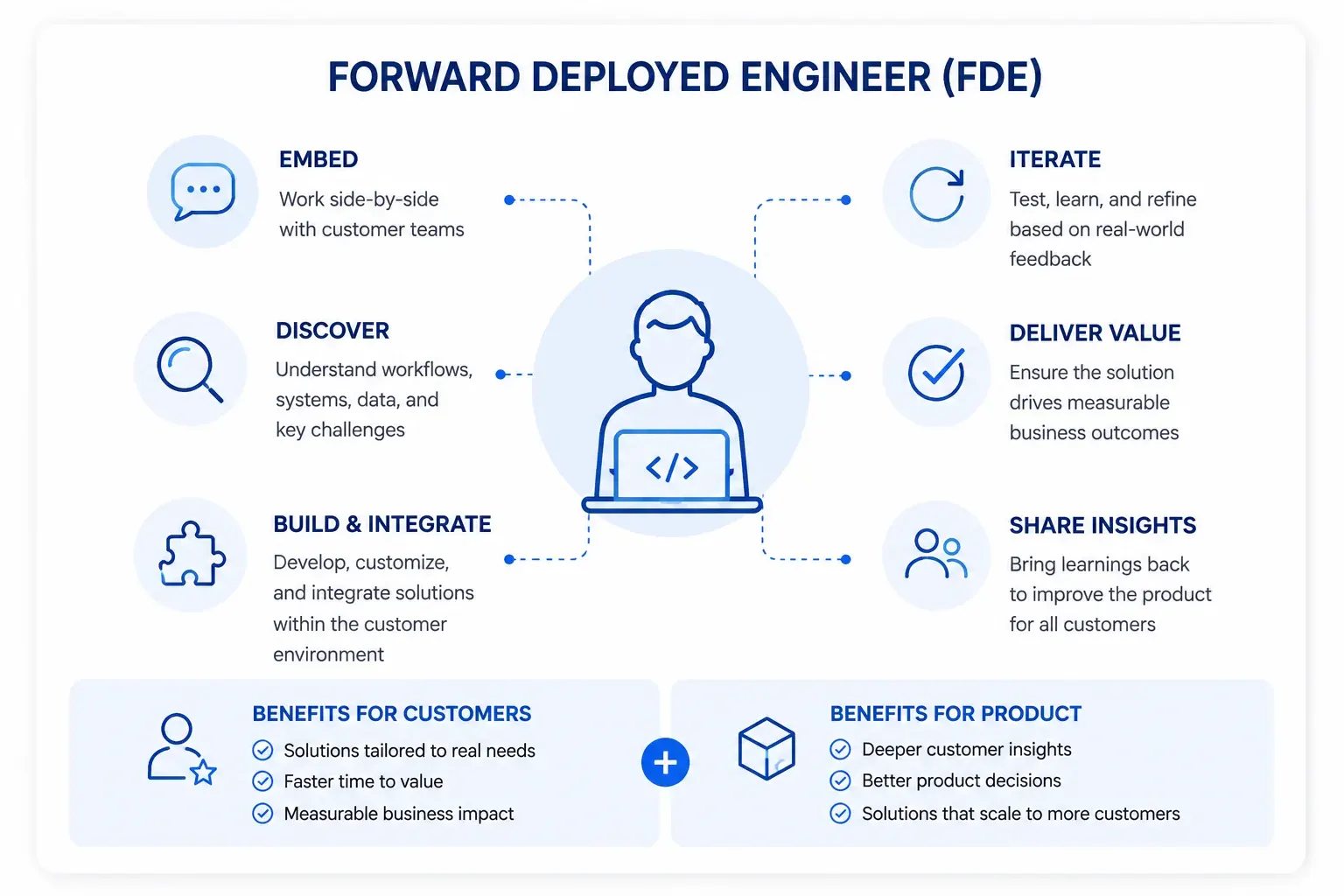
The main benefit of forward deployed engineering is that FDEs gain firsthand insight into the customer’s tech stack, pain points, and implementation challenges. These insights can then inform core product development, helping teams create solutions that scale across customers. It’s a win-win: customers get tailored solutions, while product teams gain real-world feedback.
What Are the Core Skills of Forward Deployed Engineers?
A successful forward deployed engineer needs more than strong software engineering skills. The role sits at the intersection of engineering, product development, consulting, and customer engagement.
This combination of technical depth and business fluency is what distinguishes FDEs from engineers who primarily work within a product or engineering organization.
While the exact skill set varies by project, four core pillars define a strong FDE:
1. Strong Software Engineering Fundamentals
- Work across backend, frontend, APIs, databases, and cloud infrastructure
- Integrate new solutions with existing enterprise systems, legacy infrastructure, and third-party platforms
- Build and maintain data pipelines and system integrations
- Debug issues directly in customer environments and implement fixes quickly
- Adapt to unfamiliar technology stacks and development environments
2. Customer Communication and Problem Solving
- Work directly with customers to understand their workflows, challenges, and technical environments
- Conduct discovery sessions and ask questions that uncover the underlying problem rather than simply implementing the requested feature
- Translate business requirements into clear technical requirements
- Explain technical concepts, limitations, and trade-offs to non-technical stakeholders
- Collaborate efficiently with developers, product teams, business users, and executives
- Troubleshoot problems collaboratively and find practical solutions under real-world constraints
3. Applied AI and Data Expertise
- Work with large language models, AI APIs, and AI-powered applications
- Integrate AI capabilities into existing applications, workflows, and enterprise systems to enable AI transformation
- Build AI agents and agentic workflows
- Provide AI consulting and practical solutions
- Work with structured and unstructured enterprise data
- Build data pipelines and connect AI systems to relevant data sources
- Translate AI capabilities into practical solutions for specific business use cases rather than treating AI as a standalone technology
4. Business and Product Thinking
- Connect engineering decisions to measurable outcomes such as cost reduction, productivity, revenue, automation, and improved customer experience
- Identify high-value opportunities where technology can solve an actual business problem
- Prioritize solutions based on business impact rather than technical complexity alone
- Feed customer insights back to product and engineering teams
- Balance customization for individual customers with scalability and long-term product strategy
- Stay focused on whether the implemented solution delivers tangible business value, not simply whether the software has been deployed
Core Responsibilities of Forward Deployed Engineers
The day-to-day work of a forward deployed engineer looks similar to that of a software engineer, but with one important difference: the FDE works directly with customers and builds solutions around their specific needs. This often means spending a lot of time in customer meetings, collaborating with business and technical stakeholders, and, depending on the company, traveling to customer sites.
A typical FDE workflow includes:
- Understanding the customer's problem. Meet with customers and stakeholders to understand their workflows, identify pain points, and define the technical problems that need to be solved.
- Designing and building tailored solutions. Translate customer requirements into working software by designing, developing, testing, and iterating on solutions that fit the customer's technical environment.
- Configuring and integrating existing technologies. Adapt existing products, APIs, AI models, and infrastructure to the customer's specific use case.
- Testing and deploying solutions in real environments. Move beyond prototypes by validating solutions with real users and data.
- Working with internal product and engineering teams. Bring customer feedback, technical requirements, and implementation insights back to the teams responsible for the core product. FDEs can therefore play an important role in identifying product improvements and new capabilities.
Why Are Companies Actively Hiring Forward Deployed Engineers?
Customers no longer need another AI model or another AI platform. They need AI that delivers results inside their own business. That's the job of a forward deployed engineer.
Rather than build generalized features for a broad market, FDEs solve specific problems for individual customers. They work inside the customer's environment, embedded in its workflows, data systems, and decision-making.
The model is spreading fast. Google Cloud CEO Thomas Kurian recently announced a major push to hire FDEs, positioning them as the way to move enterprises beyond experimentation into full-scale AI operations. Kurian stated that FDEs will help them scale AI transformation.
Salesforce has committed to building a team of 1,000 FDEs, some working in “pods” of one deployment strategist and two engineers who embed full-time with a single client for about three months to ship AI agents into production.
Beyond customization, several factors make FDEs especially valuable for AI, including:
1) AI raises the stakes on privacy and security. Companies are cautious about sharing sensitive data with AI vendors. FDEs work within the customer’s environment, helping handle data while meeting security and compliance requirements.
At Akveo, for instance, we adapt the architecture to the client’s compliance needs. We typically connect AI features directly to providers such as OpenAI or Anthropic, both of which offer no-training data policies. For stricter requirements, FDEs can route the same models through AWS Bedrock or Microsoft Azure AI, keeping data within the client’s existing cloud environment and compliance perimeter.
2) Decision-makers are still skeptical about AI. Many executives want proof before investing in AI. FDEs provide it by applying AI to real business problems using the customer’s own data.
3) AI implementation is rarely straightforward. Moving from prototype to production requires integrations, data preparation, monitoring, and handling real-world edge cases. FDEs manage much of this hands-on implementation.
4) AI adoption changes how people work. Even strong AI solutions can fail if they don't fit existing workflows. FDEs adapt the technology to how teams actually work, making AI part of the process rather than another standalone tool.
Teams introducing AI into real engineering workflows can also use our AI delivery workflows to move from assisted coding to repeatable, production-ready delivery.
Ultimately, forward deployed engineers are the hands-on link between what AI can do and what a business actually gets from it. They turn AI capabilities into solutions that fit real workflows, work with real data, and deliver measurable business value.
Forward Deployed Engineer vs Software Engineer: Key Differences
FDEs still do software engineering, but their work extends well beyond writing code. Compared with traditional software engineers, they spend significantly more time working directly with customers, understanding their challenges, and defining project requirements. Their priority is to understand the customer's problem deeply and determine what should be built to solve it effectively.
Traditional software engineers are generally more focused on developing scalable, reusable, and maintainable features for the broader product. They typically have less direct customer interaction and concentrate on building solutions that can serve many users and use cases.
| FDE | Software Engineer | |
|---|---|---|
| Primary focus | Solving a specific customer’s problem | Building features for the broader product |
| Customer interaction | Frequent, often direct and ongoing | Usually limited or indirect |
| Type of work | Custom solutions, integrations, prototypes, and deployments | Generalizable product features and core systems |
| Work environment | Often embedded in the customer's environment | Primarily works within the company's engineering environment |
| Technical breadth | Broad: full-stack, data, infrastructure, AI, integrations | Often deeper specialization in a specific technical area |
| Feedback loop | Direct feedback from customer | Feedback usually comes through analytics and support |
Forward Deployed Engineer vs Consultant: Key Differences
Forward deployed engineers and consultants both work closely with customers and help solve complex business problems, but they approach those problems differently.
Consultants typically focus on understanding the problem, developing a strategy, and recommending what the client should do.
FDEs go a step further: they help design, build, integrate, deploy, and iterate on the actual technical solution. Their role is more hands-on and closely tied to implementation.
| FDE | Consultant | |
|---|---|---|
| Primary focus | Building and implementing solutions for specific customer problems | Analyzing problems and recommending strategies or solutions |
| Technical involvement | Hands-on development, integration, testing, and deployment | Usually provides guidance, analysis, and oversight |
| Deliverable | Working software or technical solution | Strategy, recommendations, roadmap, implementation plan |
| Problem-solving approach | Build, test, deploy, and iterate | Analyze, advise, and recommend |
| Technical skills | Strong software engineering and technical implementation skills | Strong business, analytical, and domain expertise |
When Do You Actually Need to Hire a Forward Deployed Engineer?
Forward deployed engineering is not necessary for every product or customer. FDEs make the most sense when a solution requires deep technical involvement together with close collaboration with the customer to deliver measurable results.
Here are the situations where hiring an FDE can make the biggest difference:
1. Your Product Requires Deep Hand On Implementation
When your product has to integrate with complex infrastructure, proprietary data, or multiple enterprise systems, standard onboarding won't cut it. FDEs work directly in the customer's environment to handle integrations, customization, testing, and deployment.
2. You Work in a Highly Regulated Industry
Healthcare, finance, and government come with strict requirements around security, data access, compliance, and infrastructure. FDEs work alongside customer teams to understand those constraints and build solutions that fit them.
3. You Are Entering a New Market or Customer Segment
Product teams often don't yet understand a new market's workflows and requirements. An FDE can embed with early customers, learn how they operate, spot gaps in the product, and build around real use cases.
4. You’re Deploying AI That Must Deliver Real Business Outcomes
AI can work in a demo and still fail in production, where deployments have to connect models to company data, existing systems, workflows, and decision-making.
As this implementation gap becomes more apparent, companies are increasingly turning to FDEs to accelerate AI adoption. According to Gartner analyst Alex Coqueiro, more than 85% of tech providers are expected to launch FDE programs by the end of 2026, using specialized engineering talent to accelerate enterprise AI adoption and shorten deployment timelines.
5. You Have Enterprise Customers That Need Faster Time-to-Value
Large or strategic customers expect more than access to a product. They need help adapting it to their environment and proving its value quickly. An FDE works directly with them to identify high-impact use cases, build an initial solution, and iterate on real feedback, creating a tighter loop that accelerates adoption and expansion.
Hire Forward Deployed Engineer at Akveo
At Akveo, our experienced FDEs combine deep technical expertise with a strong understanding of business needs. We work across AI development, from AI-powered software to agentic engineering, helping businesses adopt AI in ways that deliver measurable value.
Contact our team to discuss your goals, and our FDEs will help turn them into a practical solution and support you throughout your business transformation journey.
Frequently Asked Questions
What is an FDE?
An FDE, or forward deployed engineer, is a software engineer who works directly with customers to understand their challenges and build, integrate, and deploy tailored technical solutions.
What does forward deployed mean?
The forward deployed meaning refers to engineers working close to the customer rather than solely within an internal product team. They operate in the customer’s environment to solve specific technical and business problems.
What does a forward deployed engineer do?
A forward deployed engineer combines software development with customer discovery and problem-solving. Their responsibilities can include designing solutions, building integrations, deploying AI systems, troubleshooting issues, and iterating based on customer feedback.
When should you hire a forward deployed engineer?
You should hire a forward deployed engineer when your solution requires significant customization, complex integrations, or close collaboration with customers. FDEs are particularly useful for enterprise AI developments, regulated industries, and new or highly specialized markets.
Reference Sources
- Hilgers, Laura, Salesforce (November 19, 2025). Today’s Hottest Role: Forward Deployed Engineer. Salesforce. Accessed August 20, 2026.
- Ashare, Matt, Channel Dive (May 13, 2026). Google Cloud is hiring an army of AI deployment engineers. Channel Dive. Accessed August 20, 2026.
- ET Online, The Economic Times (November 2, 2025). What are the hottest jobs within AI? Hiring up 800% this year. The Economic Times. Accessed August 20, 2026.
- Cottier, Ben et al., Epoch AI (June 3, 2024). FDE Scarcity Study 2026. Accessed August 20, 2026.
- Holland, Makenzie, CIO Dive (August 3, 2026). Enterprises seek help to deploy AI as complexity mounts. CIO Dive. Accessed August 20, 2026.