

$100K saved per subscription
Now, the customer saves approximately $100.000 per subscription.
The implementation of the data warehouse, ELT process, Customer Portal, and Reports.

[ Client ]
A supplier of technology solutions in the automotive industry.
[ Challenge ]
The client has been acquiring electronic parts catalogs for years, spending $5000-50000 per month on each catalog.
Our team accepted the challenge to develop a solution that generates and updates the catalogs from five manufacturers based on source data.
[ Solution ]
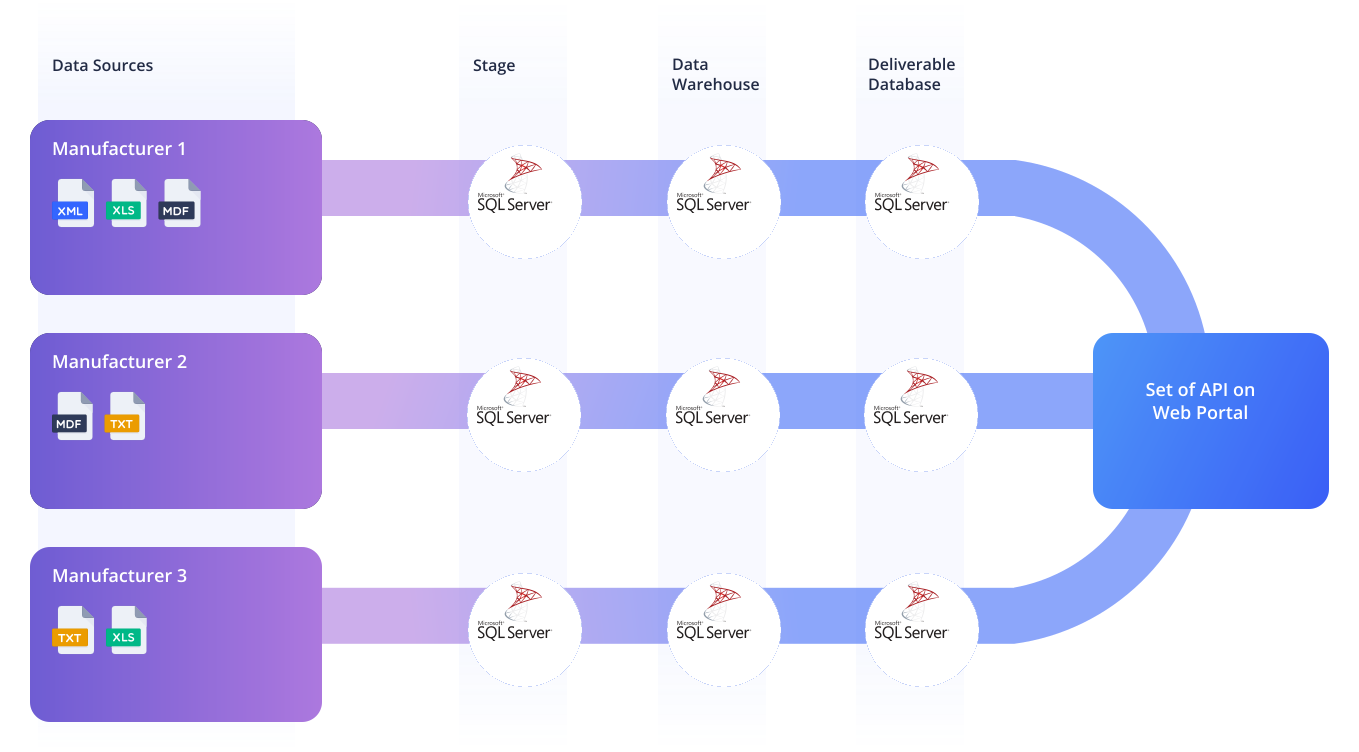
Each manufacturer has their source data in a specific format - text files, XML, Excel, databases (.MDF), and even EBCDIC - the format used since the 50s on IBM mainframes. The goal was to build ETL pipelines that would transform diverse source data and enable a single set of APIs to query all catalogs.
Stage raw data is imported into MS SQL Database, then cleaned and validated. The stage only contains a set of processed data that is cleared at the beginning of each ETL run. Data Warehouse is a permanent data storage that includes integrated and normalized data sets (not a canonical data warehouse).
Deliverable Database contains data with applied business rules and transformations required to enable access via APIs. In their turn, APIs are implemented as SQL procedures.
[ Results ]
The client now generates and maintains all five catalogs in-house, eliminating recurring vendor subscription costs and gaining full control over updates.
Now, the customer saves approximately $100.000 per subscription.
High-quality catalogs save resources on maintenance.
We enabled full access to catalogs and the ability to update catalogs at any time.
[ Case Studies ]
We have helped over 200 businesses grow their value and improve how they work through better software.
Let’s discuss your goals and how AI can help you achieve them faster.