
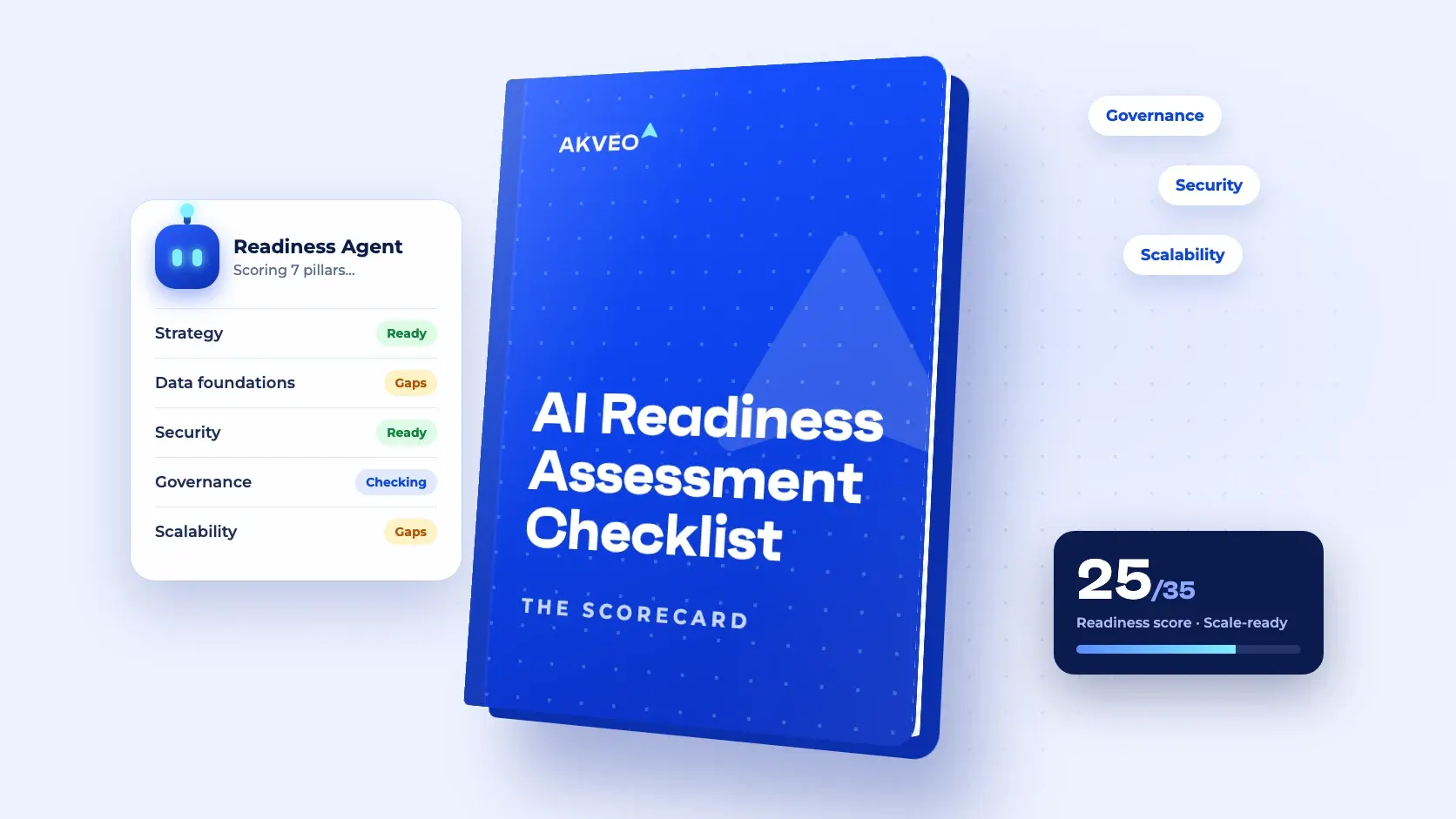
- An AI readiness assessment checks if your company can move AI from a demo to real work. It looks at strategy, data, infrastructure, security, governance, people and operations.
- This checklist has 35 yes/no questions in 7 pillars, plus 5 extra questions for AI agents. Every yes is one point.
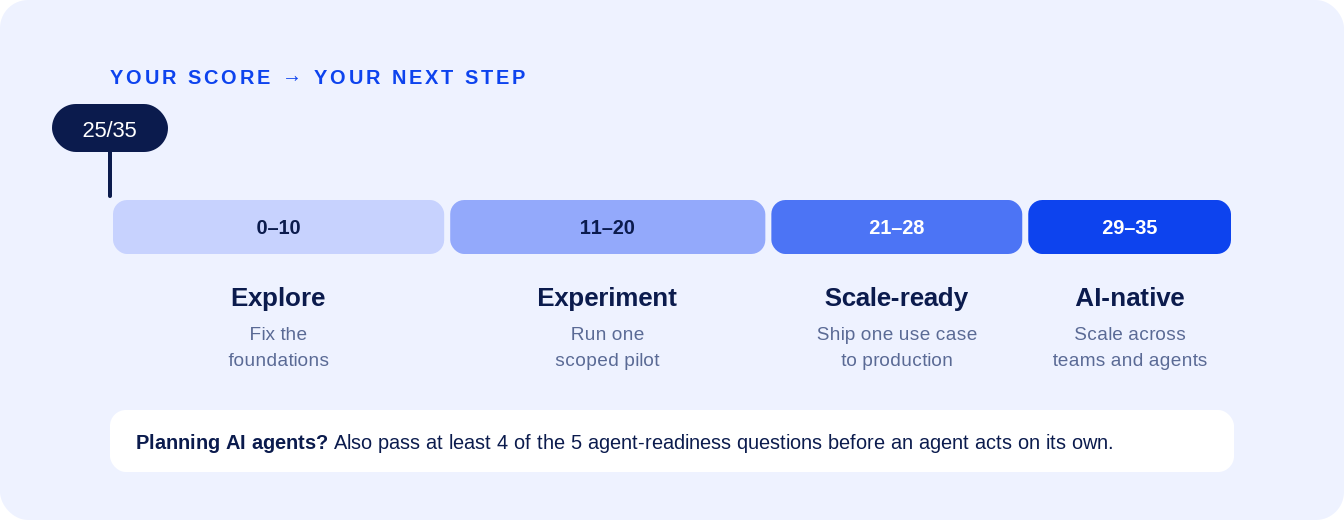
- Your score shows your next step: fix the foundations (0–10), run one pilot (11–20), ship to production (21–28) or scale across teams (29–35).
- Data is the most common blocker. Gartner expects companies to abandon 60% of AI projects without AI-ready data through 2026.
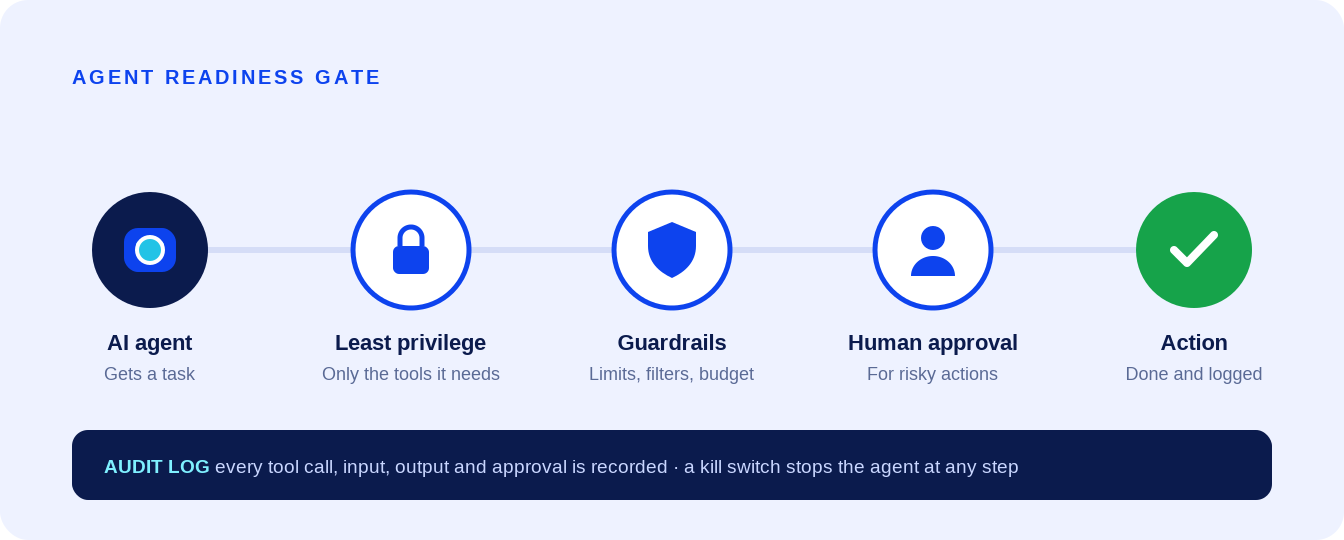
- Before an AI agent acts on its own, it needs limited access, guardrails, human approval for risky steps and full logs.
Most companies do not fail at AI because the model is bad. They fail because the data is scattered, nobody owns the project, security says "no" at the last minute, or the pilot works but nobody can run it in production.
An AI readiness assessment finds these problems before you spend money on them. Microsoft and Cisco offer free online assessments, and consulting firms sell big ones. But most teams just need a quick, honest answer: are we ready, and what should we fix first?
This guide gives you that answer in one page. It is a checklist of 40 yes/no questions. You score yourself, and your score tells you your next step.
What Is an AI Readiness Assessment?
An AI readiness assessment is a check of how prepared your company is to build, run and scale AI. It does not test one tool. It tests the whole system around AI: goals, data, technology, security, rules and people.
Think of it like a pre-flight check. The plane may be brand new, but if the fuel, the crew or the weather is not ready, it does not take off.
A good assessment answers three questions:
- Where are we today? A clear score per area, not a feeling.
- What blocks us? The two or three gaps that will stop the first real project.
- What do we do next? One concrete step that fits our level.
People also call it an AI maturity assessment. The difference is small: readiness asks "can we start or scale?", while maturity asks "how advanced are we?". This checklist covers both.
Why AI Projects Stall Before Production
Most companies already use AI somewhere. Few get real value from it at scale. The numbers from the big research firms tell the same story.
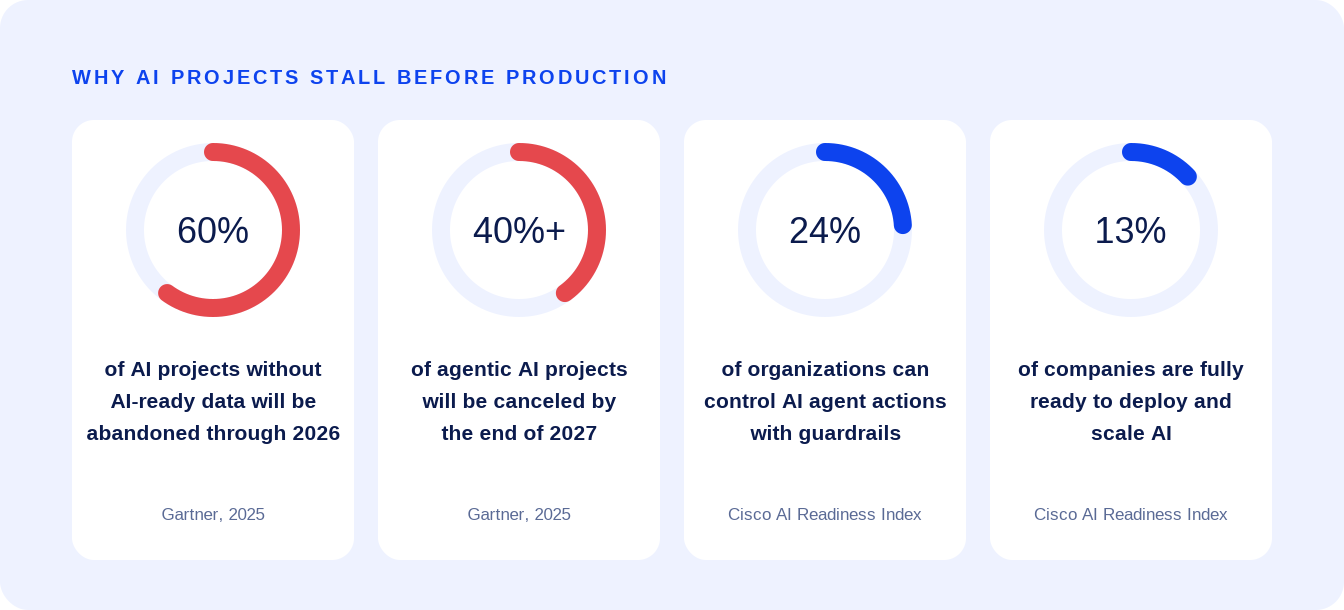
- Data is the first blocker. Gartner predicts that through 2026, organizations will abandon 60% of AI projects that are not supported by AI-ready data.
- AI agents raise the bar. Gartner also expects over 40% of agentic AI projects to be canceled by the end of 2027, because of rising costs, unclear business value and weak risk controls.
- Few companies are fully ready. In the Cisco AI Readiness Index, only 13% of companies are "Pacesetters", fully prepared to deploy and scale AI.
- Control of agents is rare. Cisco found that only 24% of organizations can control agent actions with proper guardrails and live monitoring.
- Value is still uneven. In McKinsey's State of AI 2026 survey, 37% of respondents say AI contributes at least some EBIT, and only about 6% are "high performers".
The pattern is clear. The model is rarely the problem. The problem is everything around it, and that is exactly what a readiness check looks at.
How to Use This AI Readiness Checklist
The rules are simple:
- Pick one real use case first. For example, "an AI assistant for our support team" or "AI that reads supplier invoices". Readiness depends on the use case, so a concrete one gives honest answers.
- Answer yes or no. "Partly" or "we are working on it" counts as no. Give yourself 1 point for each yes.
- Ask several people. A CTO, a data owner, a security lead and a business owner will often score the same question differently. That gap is useful data too.
- Add up the 35 core questions. Then check your total against the score bands below.
- Planning AI agents? Also answer the 5 questions of the agent readiness gate.
It takes about 20 minutes. Do it again every quarter, or each time you start a new AI project.
The AI Readiness Assessment Checklist: 7 Pillars, 35 Questions
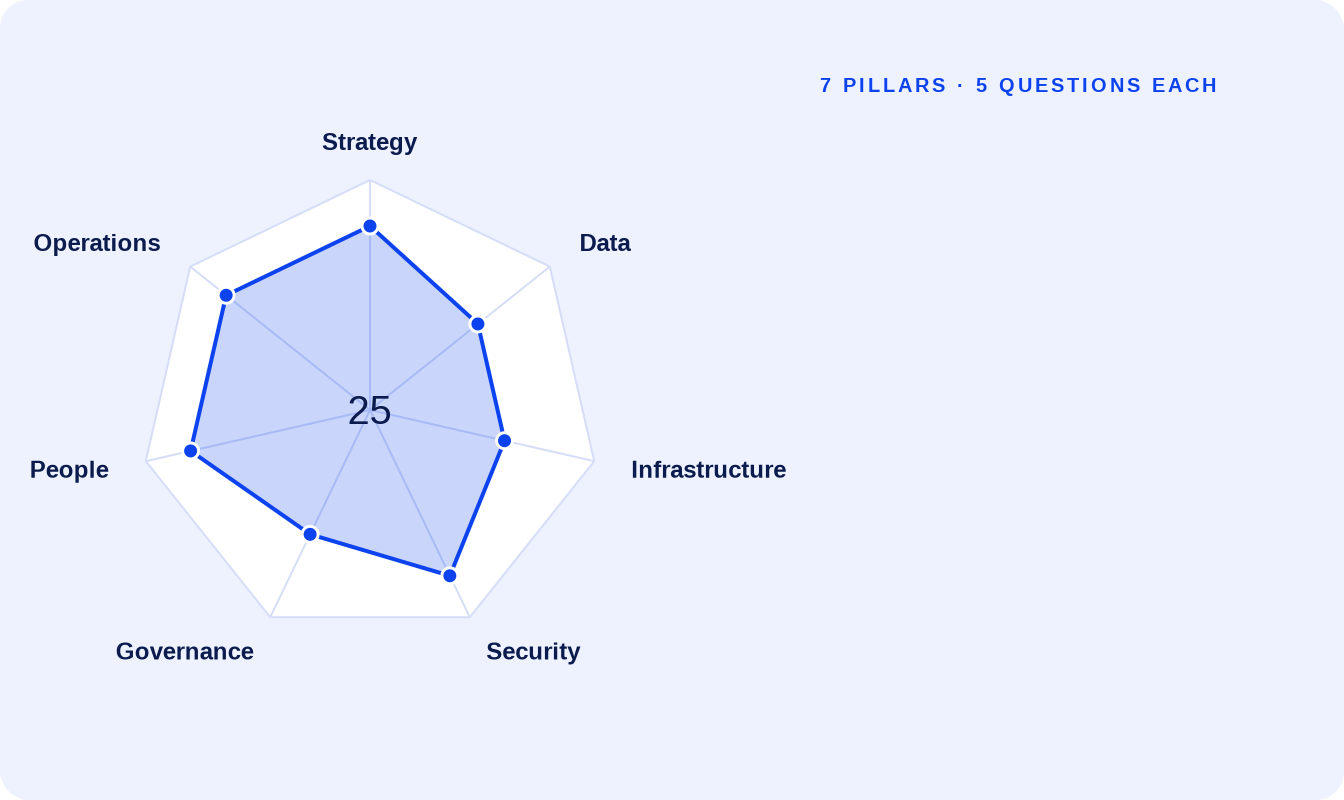
The checklist covers seven pillars. Each pillar has five questions. Below the example chart, you will find every question and a short note on why it matters.
1. Strategy and Business Value
AI without a business goal turns into an expensive demo. Cisco found that 99% of its "Pacesetters" have a well-defined AI strategy, compared with 58% of all companies.
| # | Question | Why it matters |
|---|---|---|
| 1 | Do we have 1 to 3 named AI use cases tied to a business KPI, such as cost, revenue or time saved? | A use case without a number cannot prove value |
| 2 | Does each use case have an executive owner and a budget? | Projects without an owner stall after the pilot |
| 3 | Do we know today's baseline for that KPI? | Without a "before", you cannot show an "after" |
| 4 | Did we rank use cases by value and feasibility, not by hype? | The flashiest idea is rarely the best first project |
| 5 | Did we agree in advance when to stop a pilot that does not work? | Clear stop rules save budget and time |
2. Data Foundations
This is where most teams lose points. AI is only as good as the data it can reach. Cisco found that 76% of Pacesetters have fully centralized data, compared with 19% of all companies.
| # | Question | Why it matters |
|---|---|---|
| 6 | Do we know exactly which data the first use case needs and where it lives? | Teams often find out during the pilot that the data does not exist |
| 7 | Does each key dataset have a named owner who is responsible for its quality? | Without an owner, nobody fixes errors |
| 8 | Can systems reach this data through APIs or a data warehouse, not only through spreadsheets and email? | AI needs reliable, repeatable access |
| 9 | Have we checked the quality of this data: gaps, duplicates and how fresh it is? | Bad data in means confident wrong answers out |
| 10 | Is personal and confidential data labeled, so we know what AI may and may not see? | This decides your security and compliance setup |
3. Infrastructure and Scalability
A pilot for 10 users and a system for 10,000 users are different products. Plan for scale before the pilot proves it works.
| # | Question | Why it matters |
|---|---|---|
| 11 | Have we decided where models will run: a cloud AI API, our own cloud or on-premises? | This drives cost, speed and compliance |
| 12 | Do the systems that AI must read from or write to (CRM, ERP, ticketing) have APIs? | AI that cannot connect stays a chat window |
| 13 | Have we estimated the cost per request and per user at 10 times today's volume? | Token costs can grow faster than the value |
| 14 | Can AI features use our normal dev, test and production environments and CI/CD? | AI should ship like any other software |
| 15 | Can we monitor uptime, response time and AI usage costs? | You cannot scale what you cannot see |
4. Security
AI opens new doors into your systems. Prompts can leak data, and attackers can hide instructions in documents that AI reads. Cisco found that 84% of Pacesetters use end-to-end encryption with continuous monitoring, compared with 30% of all companies.
| # | Question | Why it matters |
|---|---|---|
| 16 | Do we have a list of approved AI tools, and can we see which unapproved tools ("shadow AI") staff use? | You cannot protect what you do not know about |
| 17 | Does access to AI tools go through single sign-on and role-based permissions? | Users should only see data they are allowed to see |
| 18 | Have we tested our AI against prompt injection and data leaks? | These are the most common AI-specific attacks |
| 19 | Do our vendor contracts say whether our data may be used to train their models? | This is a top question from customers and auditors |
| 20 | Are prompts, logs and outputs with sensitive data encrypted and kept only as long as our policy allows? | AI logs are a new store of sensitive data |
5. Governance and Compliance
Governance is not paperwork. It is how you decide who may use AI, for what, and who answers when something goes wrong. We explain why this matters so much in our article on why AI transformation is a problem of governance.
| # | Question | Why it matters |
|---|---|---|
| 21 | Do we have an AI policy that people have actually read? | A policy in a drawer protects nobody |
| 22 | Is every AI system listed in one inventory, with an owner and a risk level? | Regulators and customers ask for this list |
| 23 | Have we checked which laws apply to us, such as the EU AI Act, GDPR or industry rules? | Some duties are already in force |
| 24 | Do decisions with a big impact on people have a human review step? | This keeps people in control of high-stakes outcomes |
| 25 | Do we review AI risk with a known framework, such as the NIST AI RMF or ISO/IEC 42001? | A shared framework makes reviews repeatable |
If you sell or use AI in Europe, start with our plain-language guide to EU AI Act compliance. It includes a checklist and the official free compliance checker.
6. People and Culture
AI changes how people work. If they do not trust it or do not know how to use it, adoption stays low. Cisco found that 91% of Pacesetters have full change management plans, compared with 35% of all companies.
| # | Question | Why it matters |
|---|---|---|
| 26 | Do leaders use AI themselves and talk about it openly? | Teams copy what leaders do, not what they say |
| 27 | Have staff who use AI had basic AI literacy training? | Under the EU AI Act, AI literacy duties apply since February 2025 |
| 28 | Do we have AI engineering skills in-house, or a partner who has them? | Building AI needs different skills than buying SaaS |
| 29 | Did the people who will use the AI tool help design it? | Users find the edge cases that engineers miss |
| 30 | Do we have a change plan with communication, training and a feedback loop? | Adoption is a project, not a launch email |
7. Operations and Model Management
AI does not stay the same after launch. Models get updated, data changes, and quality can quietly drop. This pillar is about keeping AI reliable every day.
| # | Question | Why it matters |
|---|---|---|
| 31 | Do we have a test set of real examples to check AI quality before every release? | Without tests, every update is a gamble |
| 32 | Do we monitor the quality of AI answers in production, not only uptime? | AI can be "up" and still wrong |
| 33 | Do we track model and prompt versions, and can we roll back fast? | Bad updates happen; recovery should take minutes |
| 34 | Do we have an incident process for AI failures? | Someone must know what to do when AI gets it wrong |
| 35 | Can we switch to another model or vendor without rebuilding the product? | Models change every few months, and prices change too |
Bonus: The AI Agent Readiness Gate
AI agents do not just answer questions. They take actions: they update records, send emails and call other systems. That is why they need one more check.
| # | Question | Why it matters |
|---|---|---|
| A1 | Does each agent have access only to the tools and data it needs for its task? | Least privilege limits the damage of a mistake |
| A2 | Do risky actions, such as payments, deletions or external emails, need human approval? | Some actions cannot be undone |
| A3 | Is every agent step logged: the tool it called, the input, the output and the approval? | Logs let you explain and fix what happened |
| A4 | Do agents have limits on budget, steps and time, plus a kill switch? | Stops loops and runaway costs |
| A5 | Did we test the agent on real edge cases before go-live? | Agents fail on the cases nobody wrote down |
Rule of thumb: answer yes to at least 4 of these 5 questions before an agent acts on its own. With fewer, keep a human in the loop for every action. If you are planning agents, see how we approach AI agent development.
How to Read Your AI Readiness Score
Add up your yes answers from the 35 core questions. Your total shows where you stand and what to do next.
| Score | Stage | What it means | Your next step |
|---|---|---|---|
| 0–10 | Explore | AI is mostly ideas and personal tools | Pick 1 use case, name an owner, and fix access to its data |
| 11–20 | Experiment | You can test AI, but production will hit blockers | Run one scoped proof of concept with clear success metrics |
| 21–28 | Scale-ready | The foundations are in place for a real launch | Ship one use case to production with monitoring and a rollback plan |
| 29–35 | AI-native | AI is part of how you work | Scale across teams, add AI agents behind the agent gate, and track ROI |
Two more tips:
- Look at the weakest pillar, not only the total. A score of 25 with only 1 point in security is not "scale-ready". Fix any pillar with 0–1 points first.
- Compare answers between people. If the CTO answers "yes" and the data owner answers "no", that question is your real blocker.
If you are at the Experiment stage, an AI proof of concept is the fastest way to test value with low risk.
How This Checklist Maps to Microsoft, Cisco and NIST
There is no single official AI readiness assessment framework. Big vendors and standards bodies each use their own pillars. We built this checklist to cover the same ground in one page.
| Our pillar | Microsoft AI Readiness Assessment | Cisco AI Readiness Index |
|---|---|---|
| Strategy and business value | Business Strategy; AI Strategy & Experience | Strategy |
| Data foundations | Data Foundations | Data |
| Infrastructure and scalability | Infrastructure for AI | Infrastructure |
| Security | AI Governance & Security | Not a separate pillar |
| Governance and compliance | AI Governance & Security | Governance |
| People and culture | Organization & Culture | Talent; Culture |
| Operations and model management | Model Management | Not a separate pillar |
For governance and risk, two standards are worth knowing:
- NIST AI Risk Management Framework (AI RMF). A free, voluntary framework from the US National Institute of Standards and Technology. It is built around four functions: Govern, Map, Measure and Manage. NIST also published a Generative AI Profile (NIST AI 600-1) in July 2024.
- ISO/IEC 42001:2023. The international standard for an AI management system. Companies can get certified against it, which helps in enterprise sales.
Free AI Readiness Assessment Tools
Our checklist is a quick self-check. If you want a deeper look, these free tools are good next steps:
| Tool | What it covers | Best for |
|---|---|---|
| Microsoft AI Readiness Assessment | 7 pillars, multiple-choice questions, personal recommendations | Teams on Microsoft Azure and Microsoft 365 |
| Cisco AI Readiness Assessment | 6 pillars, a score per pillar, and a tier from Laggards to Pacesetters | Comparing yourself with other companies |
| NIST AI RMF | Risk management functions, categories and practical guidance | Governance, risk and compliance teams |
| EU AI Act Compliance Checker | Which EU AI Act duties apply to your AI system | Companies with users in the EU |
Links: Microsoft AI Readiness Assessment, Cisco AI Readiness Assessment, NIST AI RMF. For the EU AI Act Compliance Checker, see our EU AI Act compliance guide.
Keep in mind that vendor tools are also sales tools. Their advice often points to the vendor's own products. Use them for the questions, and make your own decisions about the answers.
Common AI Readiness Mistakes
| Mistake | Why it is a problem | What to do instead |
|---|---|---|
| "We will figure out the data during the pilot" | Data gaps are the most common reason AI projects are dropped | Check data access and quality before the pilot starts |
| "Let's start with an AI agent" | Agents need the most controls and fail most often | Start with an assistant, then add actions behind the agent gate |
| "IT will handle the AI project" | Without a business owner, nobody owns the result | Give each use case an executive owner and a KPI |
| "Security can review it at the end" | Late reviews block launches for months | Bring security in at the design stage |
| "The pilot worked, so we are ready to scale" | Pilots hide costs, edge cases and support load | Estimate cost and load at 10 times the pilot volume |
| "We assessed once, we are done" | Models, data and laws change fast | Repeat the checklist every quarter |
How Akveo Helps Companies Get AI-Ready
We are an AI enablement company. We help businesses find the right AI use cases, build them, and run them safely in production. A readiness check is usually where our work starts.
Here is a real example. For a smart manufacturing client in Germany, we built Factory Copilot, an AI chatbot that lets plant operators ask questions about factory data in plain language. It pulls answers from many data sources at once: SQL databases, PDF manuals, REST APIs, Azure IoT Hub telemetry, Power BI reports and SAP ERP. The AI runs on Azure OpenAI inside the client's Microsoft Azure environment, with role-based access control and encryption. The result: 50% faster data retrieval, delivered in 5 months.
Depending on your score, we can help you:
- Explore or Experiment: pick the first use case and test it with a fast AI proof of concept.
- Scale-ready: take one use case to production with enterprise AI development and proper monitoring.
- AI-native: add AI agents with guardrails, approvals and logs.
Want to see how we use AI in our own delivery process? Get our free AI-Enabled Software Delivery playbook.
FAQ
What is an AI readiness assessment?
It is a structured check of how prepared your company is to build, run and scale AI. It covers strategy, data, infrastructure, security, governance, people and operations, and it ends with a score and a list of gaps to fix.
What are the five pillars of AI readiness?
There is no single official list. Five-pillar models usually cover strategy, data, infrastructure, governance and people. Cisco uses six pillars, splitting people into talent and culture. Microsoft uses seven. Our checklist uses seven and treats security and day-to-day AI operations as separate pillars, because they block many projects.
What are the stages of AI readiness?
Frameworks name them differently. Cisco groups companies into four tiers: Pacesetters, Chasers, Followers and Laggards. In this checklist, the four stages are Explore (0–10 points), Experiment (11–20), Scale-ready (21–28) and AI-native (29–35).
How do you measure AI readiness?
Answer clear yes/no questions for each pillar and count the points. Then look at both the total and the weakest pillar. A high total with a zero in security or data still means you are not ready to launch.
How long does an AI readiness assessment take?
A self-check with this checklist takes about 20 minutes per person. A full assessment with interviews, a data review and a roadmap takes longer. How long depends on the size of the company and the number of use cases.
Is an AI readiness assessment the same as an AI maturity assessment?
They overlap. A readiness assessment asks if you can start or scale a specific AI project. A maturity assessment asks how advanced your company is with AI overall. This checklist gives you both: a score per use case and a stage for the company.
Do we need to be fully ready before we start with AI?
No. Most companies start at the Experiment stage. The goal is not a perfect score. The goal is to know your gaps, pick a use case that fits your level, and fix the blockers for that use case first.
- Gartner (2025). Lack of AI-Ready Data Puts AI Projects at Risk. Gartner Newsroom, February 26, 2025.
- Gartner (2025). Gartner Predicts Over 40% of Agentic AI Projects Will Be Canceled by End of 2027. Gartner Newsroom, June 25, 2025.
- McKinsey & Company (2026). The state of AI in 2026: On the road to ROI. QuantumBlack, AI by McKinsey. Accessed November 23, 2026.
- NIST. AI Risk Management Framework. National Institute of Standards and Technology. Accessed November 23, 2026.
- ISO. ISO/IEC 42001:2023 Information technology — Artificial intelligence — Management system. International Organization for Standardization. Accessed November 23, 2026.