We offer the project management template that objectively measures a project's performance index and progress. Free to download, the solution represents a convenient addition to earned value management systems for businesses of any size and industry.
The main idea behind our solution is to compare costs to a budget considering the project schedule. This method is especially vital when your funds are limited.
With the Earned Management Template, project managers can detect issues at an early stage and estimate a project's costs considering actual progress. Download the template to see how it works
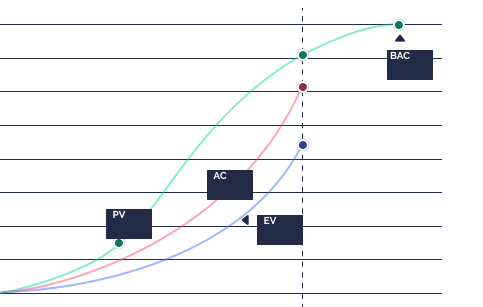
Earned value management is a technique that helps you track a project’s performance (both budget- and schedule-wise). With the free EVM template, you will be able to calculate the projected budget and schedule at the beginning or any time during project development.

When creating a project schedule, managers allocate a TBC (Total Budgeted Cost) to each and every task. If a task is lengthy, a TBC may extend over multiple periods and be non-linear.
In such a case, the EVM Template indicates the budgeted cost for each period and calculates the TBC for separate tasks. In its turn, the Planned Value is the baseline to compare the results.

The Actual Cost of Work Performed (ACWP) is the total amount spent on the project so far and other associated costs.
An essential metric to report, an Actual Cost is the amount of money you have already spent and can be attained by simply analyzing the schedule.

Using the Earned Value Management Template, project managers can calculate the EV by multiplying the percentage Complete by the TBC for every task.

EAC is the anticipated overall cost at the end of the project. EAC is the sum of Actual Cost (AC) and Estimate To Complete (ETC). EAC is calculated using various forecasting techniques.
At any moment, you can see both projected costs and schedule to compare it with your projection.

Before starting the project, structure its scope and get a detailed estimation from your development team.

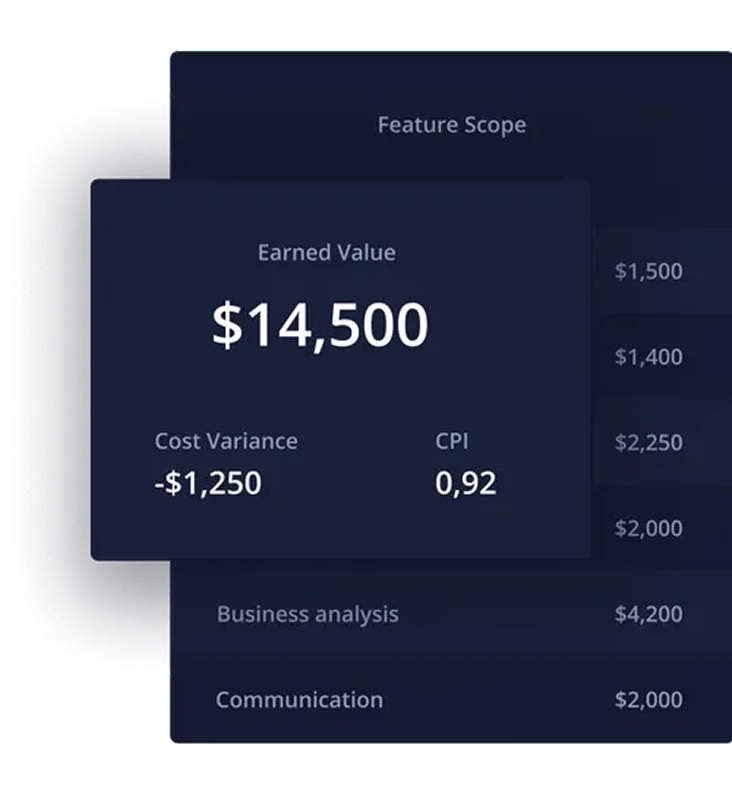
Put the functional scope and number of hours required to implement it. You need to fill separate lines for all project activities (e,g, Business Analysis, QA, etc.).
Add efforts and materials costs to each line in the table.

Set a start date for the first feature. After that, all other features will be calculated.
Update real performance with actual efforts and costs. Also, indicate the percent compete for each feature. You should update these values on a scheduled basis (preferably once a week).
95 % unserer Kunden setzen die Zusammenarbeit nach dem ersten Projekt fort, und mehr als 70 % arbeiten seit über zwei Jahren mit uns zusammen.