


Get the free AI Delivery Playbook
AkveoContact us

AI in mechanical engineering

Most US architecture and engineering workers already use generative AI, yet it saves them only a few percent of their working hours. The value comes when AI is connected to CAD, PLM and simulation data. Here is what the data says, where AI fits in the engineering lifecycle and what it means for engineering careers.

of US architecture and engineering workers used generative AI for work in Q3 2026
60.9%
average share of work hours generative AI saved these workers in the same quarter
2%
openings a year projected for US mechanical engineers from 2025 to 2035
17.8K
Two engineers reviewing a 3D design model on desktop monitors

Will AI replace mechanical engineers?

11%

Projected growth in US mechanical engineering jobs, 2025–2035

According to current data, yes. The Bureau of Labor Statistics expects mechanical engineering employment to grow from 298,500 to 332,000 jobs, faster than 8% for engineers overall and 3% for all occupations, at a median pay of $104,110. What changes is the work: less searching, drafting and repetitive CAD, more judgment, validation and work with AI tools. 47% of design and manufacturing leaders surveyed by Autodesk say the ability to work with AI will be their top hiring priority.

Most architecture and engineering workers already use generative AI

The Real-Time Population Survey tracks how many US workers use generative AI for their job. Among architecture and engineering occupations, the share roughly doubled in two years, while the time it saves moved between 1.4% and 3.3% of all work hours.

US architecture and engineering workers using generative AI for work
20%35%50%65%80%Q3 '24Q4 '24Q1 '25Q2 '25Q3 '25Q4 '25Q1 '26Q2 '26Q3 '26

Employed US adults aged 18–64 in architecture and engineering occupations, quarterly and not seasonally adjusted, so single quarters move a lot.

View data as a table
Q3 '2429.8%
Q4 '2435.7%
Q1 '2526.7%
Q2 '2541.9%
Q3 '2546.8%
Q4 '2548.2%
Q1 '2660.5%
Q2 '2649.9%
Q3 '2660.9%

A chat window is not an engineering tool

General assistants help with emails and first drafts. The gains engineering teams are after need AI that works with their own models, standards and history.

Generative AI on its own

Context
Knows what the engineer pastes into the prompt.
Standards and rules
A 2024 peer-reviewed benchmark found the leading models of the time struggled to find the right rules in engineering documents and to read drawings.
Simulation
Cannot run or replace a solver.
Knowledge
Answers disappear with the chat.

AI connected to engineering data

Context
Reads CAD metadata, PLM records, requirements and past change orders.
Standards and rules
Retrieves the relevant clause from your own standards and cites it, so an engineer can check it.
Simulation
Surrogate models trained on your simulation results give near-instant estimates while exploring designs.
Knowledge
Decisions and lessons are written back to PLM, so they stay when engineers retire or move on.

AI across the mechanical engineering lifecycle

Pick a stage to see what AI does there and which systems it has to connect to.

Requirements and standards

  • Answer questions over specifications, standards and rule books with links to the source clause.
  • Extract requirements from customer documents and flag gaps or conflicts.
  • Check designs against internal rules before review.
SystemsRequirements managementPLM document vaultSharePoint

Why engineering AI gets stuck

Autodesk surveyed 2,500 leaders in architecture, engineering, construction, manufacturing and media in 2026. Almost all use at least one AI tool and 84% report higher productivity. The hard part is connecting AI to the systems they already run.

Leaders naming each issue a major or significant AI implementation challenge, 2026
  • Integrating AI with existing systems50%
  • Lack of talent and skills47%
  • Cost of implementation44%
  • Regulatory or compliance concerns43%
  • Data quality43%
  • Measuring return on investment42%

Autodesk 2026 State of Design & Make: AI Pulse, leaders in architecture, engineering, construction, manufacturing and media in 16 countries and regions. In a separate McKinsey survey of 48 R&D leaders, only 13% of AI use cases had scaled beyond proof of concept.

View data as a table
Integrating AI with existing systems50%
Lack of talent and skills47%
Cost of implementation44%
Regulatory or compliance concerns43%
Data quality43%
Measuring return on investment42%

The skills gap behind it

Autodesk's 2025 report, based on a mid-2024 survey of 1,925 design and manufacturing leaders, shows hiring getting harder and AI skills moving to the top of the list.

59%say lack of skilled talent limits their company's growth, up from 44%
62%find new hires with the right technical skills hard to find, up from 48%
47%say the ability to work with AI will be their top hiring priority
35%are approaching or have reached their AI goals, down from 52% a year earlier

Which AI fits which engineering task

There is no single best AI for mechanical engineering. Each task needs a different approach and different data.

TaskAI approachWhat it needsWatch out for
Standards and documentationLanguage model with retrievalYour specs, standards and past reviews, indexed with access rightsAnswers without citations. Every answer must point to its source.
Concept explorationGenerative designLoads, constraints, materials and process limitsShapes that cannot be made at your cost or with your suppliers
SimulationMachine learning surrogateMany past solver runs for similar designs; public research datasets use thousandsDesigns outside the training range. Validate with the solver.
Change and BOM impactLanguage model with PLM integrationChange history, BOM structure and where-used dataWrite access to PLM. Keep an engineer approving every change.
Field failuresAnomaly detection and forecastingSensor history, maintenance logs and warranty claimsToo few failure examples and changing operating conditions

Our view

Connect AI to engineering data before you scale it

In McKinsey's 2026 survey of 48 R&D leaders across industries, data availability and quality (56%) and integration into engineering workflows and tools (50%) were the top barriers to scaling AI. That matches what we saw building Factory Copilot: the work was in connecting telemetry, documents and SAP data, not in the model. Pick one workflow, such as standards questions or change impact, connect it to PLM and CAD data, keep an engineer signing off and measure the hours saved before adding the next one.

Not sure where AI fits in your engineering process?

We review your CAD, PLM and simulation setup and show which workflow AI can speed up first.

Book a consultation
[ Process ]

How to start with AI in an engineering team

Small, measured steps with engineers in control.

  1. Choose one workflow

    Pick a frequent task with a clear owner, such as answering standards questions or drafting change requests, and agree how success is measured.

  2. Measure today's baseline

    Record how long the task takes now and how often it goes wrong, so results can be compared.

  3. Connect the data

    Integrate the PLM, CAD metadata and document stores the workflow needs, with the same access rights engineers have.

  4. Build with citations

    Make every answer and suggestion point to its source model, document or record, so engineers can check it quickly.

  5. Pilot with one team

    Run it on live projects with engineer sign-off and compare time and errors against the baseline.

  6. Scale and add workflows

    Roll out to more teams, then move to the next workflow on the same data layer.

[ Case Studies ]

Our closest work

Not mechanical design projects, but AI systems built on production and diagnostic data.

ManufacturingAI Development

Factory Copilot for Smart Manufacturing

50% faster data retrieval

For one of the largest consulting firms, we added an AI assistant to its Factory Intelligence platform. Operators and plant managers ask in plain language about real-time telemetry, alert statistics, production KPIs and equipment manuals, without waiting for IT.

See more details
Factory Copilot for Smart Manufacturing
AutomotiveAI Development

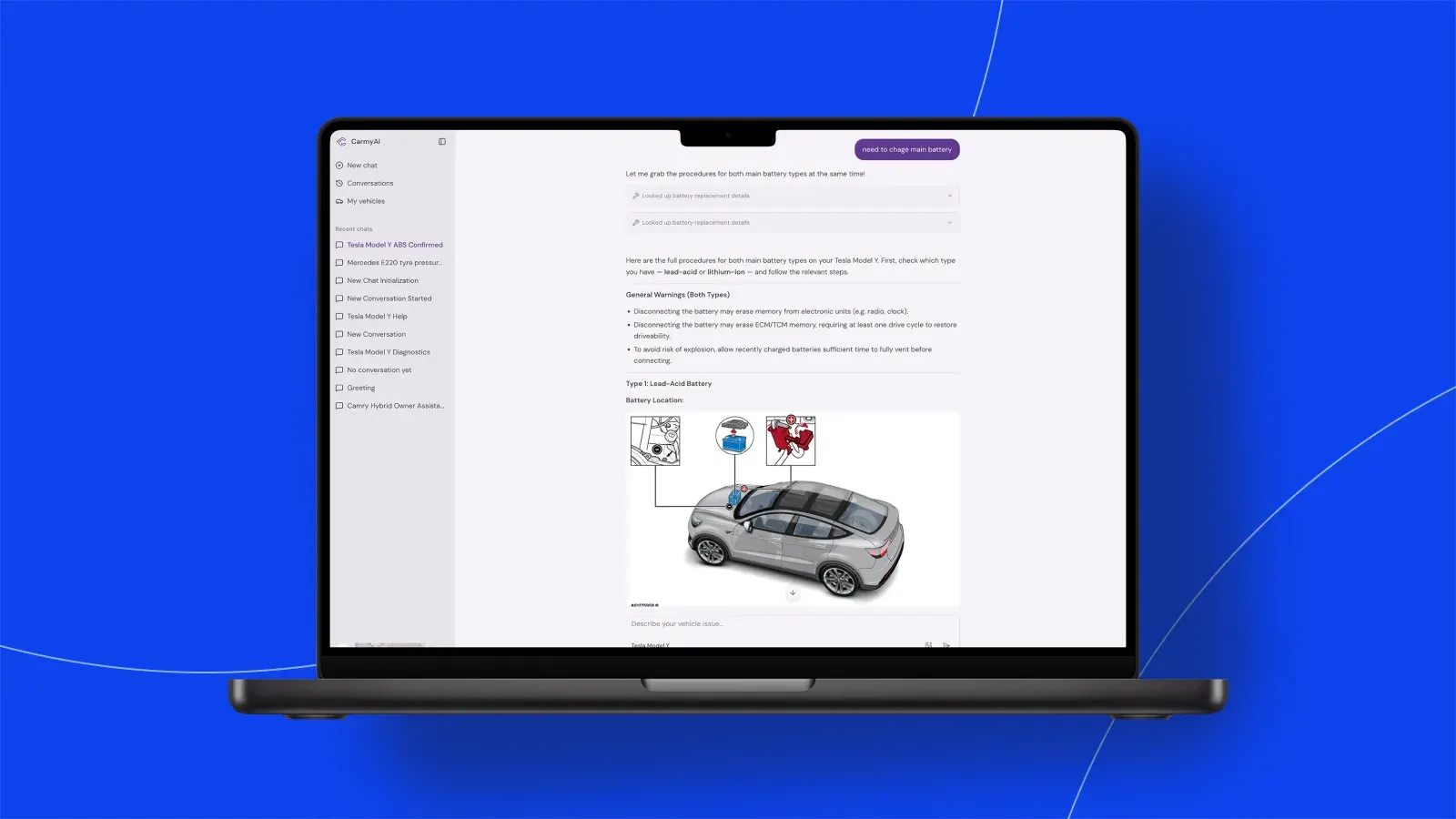
AI Car Diagnostic for a Swedish Automotive Company

24 specialized diagnostic tools

We built a virtual mechanic that turns a symptom description, a fault code or a photo into a diagnosis, a cost estimate and next steps, backed by real repair data.

See more details
AI Car Diagnostic for a Swedish Automotive Company

Sources

  1. US Bureau of Labor Statistics, Occupational Outlook Handbook: Mechanical Engineers · 2025–2035 projections
  2. Real-Time Population Survey via FRED, Generative AI adoption rate for work: Architecture and Engineering Occupations · Bick, Blandin and Deming, Q3 2024–Q3 2026
  3. Real-Time Population Survey via FRED, Generative AI time savings: Architecture and Engineering Occupations · Q4 2024–Q3 2026
  4. Autodesk, 2026 State of Design & Make: AI Pulse · 2,500 leaders in 16 countries and regions, January–February 2026
  5. Autodesk, 2025 State of Design & Make: Design and Manufacturing · 1,925 design and manufacturing leaders surveyed in mid-2024, published April 2025
  6. McKinsey, Rewiring R&D for the agentic age · 2026 R&D Leaders Survey, 48 respondents, October 2026
  7. Doris et al., DesignQA: A Multimodal Benchmark for Evaluating LLMs' Understanding of Engineering Documentation · ASME Journal of Computing and Information Science in Engineering, December 2024
  8. Elrefaie et al., DrivAerNet++ (NeurIPS 2024) · 8,000 car designs, about 3 million CPU-hours of simulation
  9. World Economic Forum, Future of Jobs Report 2025 · 1,000+ employers, January 2025
[ FAQ ]

Frequently asked questions

Discuss AI for your engineering team

Tell us about your CAD, PLM and simulation tools and the workflow that takes your engineers the most time. We will come back with where AI pays off first and a rough estimate.

Dmitry Klim
Dmitry Klim
Head of Growth
Clutch
5900 Balcones Drive #21729, Austin, TX 78731[email protected]+1 (512) 228-8585