
Lesson and materials co-pilot
Generates and adapts lessons, worksheets and reading levels from the approved curriculum, including accommodations. Needs the LMS, the content library and curriculum standards.
Teachers and students adopted AI faster than their schools wrote rules for it. Here is what the research says about adoption, workload and learning outcomes in K-12 and higher education, and what it takes to bring AI into the systems schools and universities already run.

RAND surveys of US teachers, students and principals from 2024–25 show AI use doubling in a year while schools are still writing the rules.
The jump was largest in secondary schools. Elementary teachers use AI far less, which matters for how tools are designed and introduced.
RAND American Teacher Panel, weighted to be nationally representative: 8,814 teachers in spring 2024 and 8,601 in spring 2025.
| All teachers, 2023–24 | 25% |
|---|---|
| All teachers, 2024–25 | 53% |
| Elementary, 2024–25 | 42% |
| Middle school, 2024–25 | 64% |
| High school, 2024–25 | 69% |

Teachers work about 10 hours a week more than they are contracted for, and most schools struggle to fill vacancies.
RAND's 2025 State of the American Teacher survey found teachers working 49 hours a week on average, with 53% reporting burnout. About a quarter of teachers rank administrative work or hours beyond the contract among their top three sources of stress. Before the 2024–25 school year, 74% of US public schools had difficulty filling at least one teaching vacancy.
AI is already giving some of that time back. In a Gallup and Walton Family Foundation survey, teachers who use AI at least weekly estimated saving 5.9 hours a week, about six weeks over a school year. Schools with an AI policy saw larger savings across all teachers than schools without one.
The strongest use cases work inside the LMS and student information system schools already use. Pick a role to see what AI does and which systems it needs.
Generates and adapts lessons, worksheets and reading levels from the approved curriculum, including accommodations. Needs the LMS, the content library and curriculum standards.
Drafts rubric-aligned feedback on essays and problem sets. The teacher reviews and approves before anything reaches students. Needs the LMS gradebook and rubrics.
A tutor limited to course materials that guides students to answers instead of handing them out. Launches inside the LMS with the school's single sign-on.
Explains assignments, tracks deadlines and helps students explore course and career pathways. Needs the LMS calendar, the SIS and degree-audit data.
Drafts multilingual messages to families, summarizes meetings, builds reports and answers policy questions from the handbook. Needs the SIS, email and document storage.
Combines attendance, LMS activity and grades to flag students who may need help, for an advisor to follow up. Needs the SIS, LMS data and the data warehouse.
An approved assistant hosted in the institution's own tenant, with single sign-on, logging and access rules, so staff stop using tools the school cannot see.
Adaptive practice, question generation, automated feedback and conversational help, delivered as LMS tools through LTI or inside the product.
Content tailored to each learner's level and goals, with rostering from the school's systems and consent flows that meet COPPA for younger users.
HEPI's annual survey of UK undergraduates shows AI use becoming close to universal in two years, including for work that is graded.
HEPI and Kortext Student Generative AI Survey of UK full-time undergraduates; the 2025 and 2026 waves each surveyed about 1,050 students. Use of generative AI for assessed work rose from 53% to 88% to 94% over the same surveys.
| 2024 survey | 66% |
|---|---|
| 2025 survey | 92% |
| 2026 survey | 95% |
EDUCAUSE surveyed 1,960 higher education staff, faculty and leaders in late 2025. Their top hopes for AI are automating repetitive processes (70%) and offloading administrative work (65%), but policy awareness, approved tools and measurement lag behind.
Rigorous evidence is still thin: a 2026 federal research review found only 20 studies with causal evidence on AI's impact in education, and warned that general-purpose AI may hinder learning when it reduces students' effort. Two randomized studies stand out, both with AI used inside a structured teaching design.
| Study | Setting | Result | Keep in mind |
|---|---|---|---|
| Harvard, Scientific Reports 2025 | 194 introductory physics students, randomized crossover design | Median learning gains more than double those of in-class active learning, in less time on task | One course and one institution, with a tutor built on research-based teaching design |
| World Bank, Nigeria 2025 | Senior secondary students in Edo State, six weeks of teacher-led sessions using Microsoft Copilot with curriculum-aligned prompts | Gains of 0.31 standard deviations overall and 0.23 in English, equal to 1.5–2 years of regular schooling | Published as a working paper, not yet peer reviewed |
Our view
More than half of higher education staff already use AI tools their institution does not provide. An approved assistant inside the LMS and SIS, grounded in the institution's own content, with access rules, logging and a teacher in control of anything that reaches a student, gives them a better option and gives the institution visibility.
Schools can share education records with an AI vendor without consent only if the vendor acts as a school official: it does work staff would otherwise do, stays under the school's direct control and uses the data only for that purpose.
The FTC's amended children's privacy rule requires separate parental consent before sharing children's data with third parties and limits how long it can be kept. Most changes apply from April 22, 2026.
In July 2025 the US Department of Education confirmed that federal grant funds can pay for AI-based instructional materials, AI-enhanced high-impact tutoring and college and career advising, if the use aligns with existing program requirements. It also stresses privacy and involving parents.
AI used to decide admission or placement, evaluate learning outcomes, determine the level of education a student can access or detect cheating during tests is high-risk. After the AI Omnibus, these rules apply from December 2, 2027.
Planning AI for your school, university or EdTech product?
We review your LMS, SIS and content and show where AI saves staff time or improves learning first.
Start with one group of users and one problem, and keep educators in control.
Decide what staff and students may use AI for, how work is assessed and which data may be shared, before rolling out tools.
Choose a frequent task with clear value, such as feedback drafts or parent communication, and measure how long it takes today.
Integrate with the LMS through LTI, the SIS and single sign-on, with data kept in the institution's own environment.
Limit answers to the curriculum, course materials and policies the institution approves, with sources shown.
Run it with one department or grade level, collect feedback from teachers and students and compare time and outcomes with the baseline.
Train staff on real tasks, then extend to more groups and workflows on the same platform.
Akveo builds AI-powered learning products and education platforms, including one with more than 200,000 active users.
Launched in 7 months
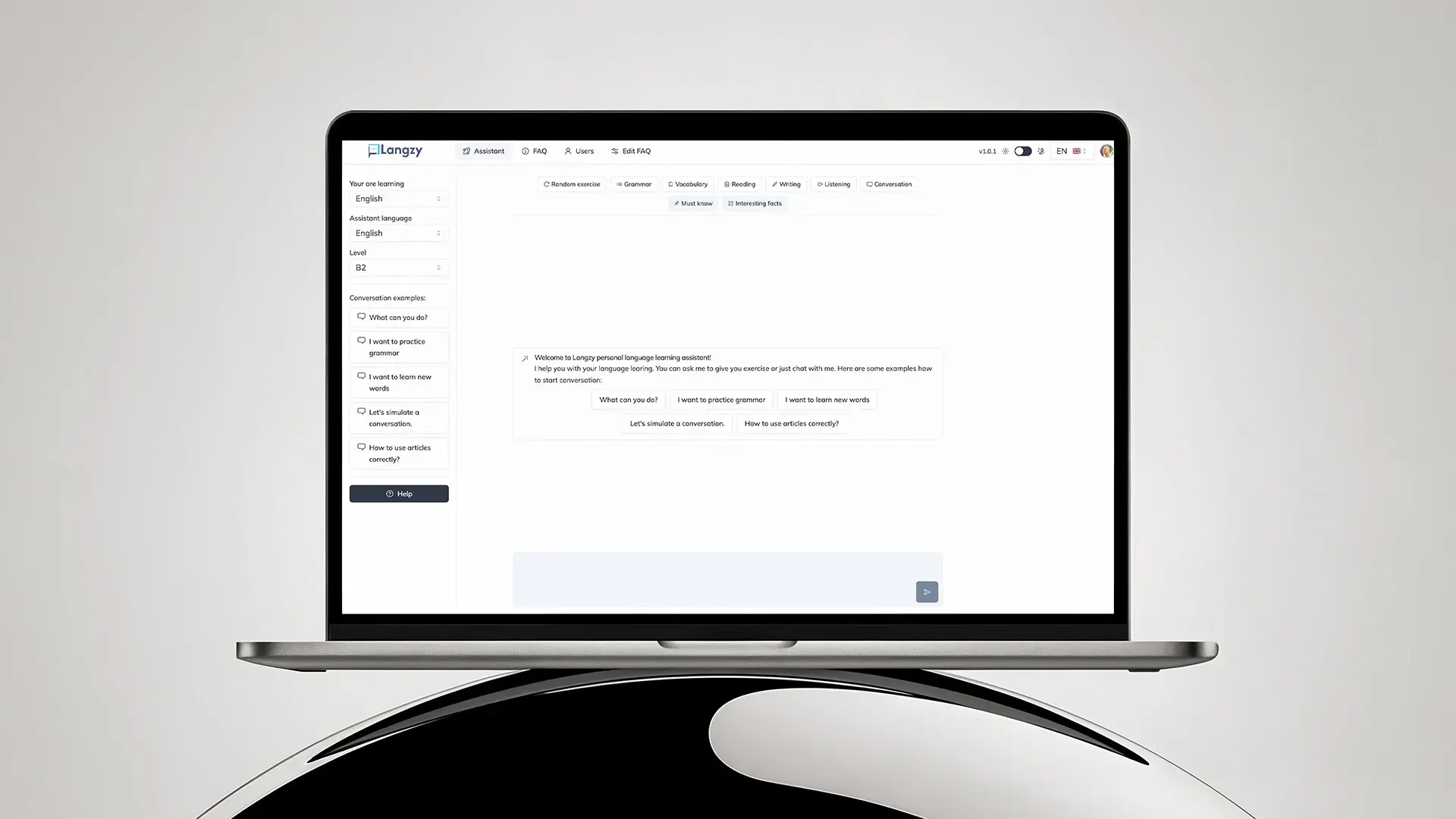
For Skrivanek, an EU language services company, we built a SaaS language learning platform with AI-personalized content for each learner's level and goals, user management for learners, corporate clients and administrators, and a full payment system.
200,000+ active users, 1 million grades a day
We built and redesigned the React Native app for the largest educational information platform in Latvia and Estonia, where schools, parents and students track grades, tasks and messages.

Sources
Tell us about your users, your LMS and SIS and the problem you want AI to solve. We will come back with where to start and a rough estimate.